Fabula, la recherche en littérature (actu)

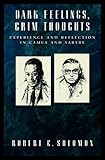
R.C. Solomon, Dark Feelings, Grim Thoughts. Experience and Reflection in Camus and Sartre

Parution livre

Information publiée le dimanche 20 août 2006 par Julien Desrochers


_blank


SOLOMON, Robert C., Dark Feelings, Grim Thoughts. Experience and Reflection in Camus and Sartre, Oxford University Press (USA), 2006, 256 p.


ISBN13: 978-0-19-518157-9


In the same spirit as his most recent book, Living With Nietzsche , and his earlier study In the Spirit of Hegel , Robert Solomon turns to the existential thinkers Albert Camus and Jean-Paul Sartre, in an attempt to get past the academic and political debates and focus on what is truly interesting and valuable about their philosophies. Solomon makes the case that--despite their very different responses to the political questions of their day--Camus and Sartre were both fundamentally moralists, and their philosophies cannot be understood apart from their deep ethical commitments. He focuses on Sartre's early, pre-1950 work, and on Camus's best known novels The Stranger , The Plague , and The Fall . Throughout Solomon makes the important point that their shared interest in phenomenology was much more important than their supposed affiliation with "existentialism." Solomon's reappraisal will be of interest to anyone who is still or ever has been fascinated by these eccentric but monumental figures.


Robert C. Solomon is Quincy Lee Centennial Professor of Business and Philosophy and Distinguished Teaching Professor at the University Texas at Austin. He is past President of the International Society for Research on Emotions. He is well known for his courses on "Existentialism" and has done several video and audio "Superstar Teacher" tapes for the Teaching Company, including No Excuses (on existentialism). He is also the author of In the Spirit of Hegel , A Short History of Philosophy , Spirituality for the Skeptic , Living with Nietzsche and Not Passion's Slave .


Url de référence :
http://www.oup.com/us/?view=usa


Derniers ouvrages parus :

Lexique nomade

A. Cousin de Ravel, Quignard, Maître de lecture. Lire, vivre, écrire

P. Engel, Les Lois de l'esprit. Julien Benda ou la raison

M. Crouzet, M. Myself ou La Vie de Stendhal (nouvelle version)

Laurence Brogniez (dir.), Écrits voyageurs. Les artistes et l'ailleurs

O. Biaggini, B. Milland-Bove (dir.), Miracles d'un autre genre  

Sévigné, Lettres de l'année 1671

A. Pope & J. Swift, Pensées sur différents sujets

H. Melville, Le Marchand de paratonnerres, suivi de La Véranda

Le Dit des Heiké

S. Kierkegaard, La Crise et une crise dans la vie d'une actrice

E. Maigret et M. Stefanelli (dir.), La Bande dessinée : une médiaculture

I. Raynauld, Lire et écrire un scénario - Le Scénario de film comme texte

J.-F. Bédia, Les Ecritures africaines face à la logique actuelle du comparatisme

Eusèbe de Césarée, Histoire ecclésiastique. Commentaire - Tome I : Études d'introduction

P. Engel, Les lois de l'esprit, Julien Benda ou la raison  

P. E. Fobah, Introduction à une poétique et une stylistique de la littérature africaine

M.-C. Alexandrine-Sinapah, Itinéraire d'un esclave-poète à Cuba - Juan Francisco Manzano (1797-1854) entre littérature et histoire

Cl. Launchbury, Music, Poetry, Propaganda. Constructing French Cultural Soundscapes at the BBC during the Second World War 

O. Rosenthal, Ils ne sont pour rien dans mes larmes

A. Alciato, Il libro degli Emblemi, secondo le edizioni del 1531 e del 1534

Marc Azéma, La Préhistoire du cinéma

J. Milly, Au seuil de l'image

I. Mons, Lou Andreas-Salomé. En toute liberté

N. Redouane, Lecture(s) de Rachid Mimouni

Fil d'informations RSS Fil d'information RSS   Fabula sur Facebook Fabula sur Facebook   Fabula sur Twitter Fabula sur Twitter