Fabula, la recherche en littérature (actu)

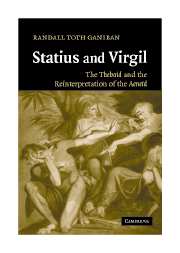
R. T. Ganiban, Statius and Virgil. The Thebaid and the Reinterpretation of the Aeneid

Parution livre

Information publiée le lundi 5 octobre 2009 par Frédérique Fleck (source : BMCR)


_blank


Randall T. Ganiban, Statius and Virgil. The Thebaid and the Reinterpretation of the Aeneid,  Cambridge:  Cambridge University Press, 2007.  Pp. 258.   ISBN 9780521840392.   $90.00.  
Recension par Bob Cowan (Balliol College, Oxford) dans Bryn Mawr Classical Review 2009.06.31.

Extraits en ligne sur amazon.com.

Présentation de l'éditeur:

At the end of the Thebaid, Statius enjoins his epic 'not to compete with the divine Aeneid but rather to follow at a distance and always revere its footprints'. The nature of the Thebaid's interaction with the Aeneid is, however, a matter of debate. This book argues that the Thebaid reworks themes, scenes, and ideas from Virgil in order to show that the Aeneid's representation of monarchy is inadequate. It also demonstrates how the Thebaid's fascination with horror, spectacle, and unspeakable violence is tied to Statius' critique of the moral and political virtues at the heart of the Aeneid. Professor Ganiban offers both a new way to interpret the Thebaid and a largely sequential reading of the poem.

Table des matières:


Preface Page vii
List of abbreviations x
1   Introduction 1
2   Oedipus' curse 24
3   Horror, prophecy, and the gods 44
4   Hypsipyle's narrative of nefas 71
5   Bacchus and the outbreak of war 96
6   Dis and the domination of hell 117
7   Delay and the rout of Pietas 152
8   Spectacle, crime, and monarchy at Thebes 176
9   Pietas, burial, and clementia in a world of nefas 207
Works cited 233
General index 243
Index locorum


Url de référence :
http://www.cambridge.org/catalogue/catalogue.asp?isbn=9780511271168&ss=fro


Derniers ouvrages parus :

Théodore Augustin Mann, Mémoires sur les grandes gelées et leurs effets

L. Hébert & L. Guillemette (dir.), Performances et objets culturels. Nouvelles perspectives

R. Corona, Mots de l'enfermement - Clôtures et silences : lexique et rhétorique de la douleur du néant

J. Hillion, Shakespeare et son double - Les Sonnets de Shakespeare à la lumière de la théorie mimétique de René Girard

Alison Boulanger et Jessica Wilker, (éd.), La posture de l'herméneute. Essais sur l'interprétation dans la littérature

Nadia R. Altschul : Geographies of Philological Knowledge. Postcoloniality and the Transatlantic National Epic

A. Matei, Jean Echenoz et la distance intérieure

P. Citti, Taine, philosophe du récit

F. Parisot (dir.), Alejo Carpentier à l'aube du XXIème siècle

Chr. Chaulet Achour (dir.), À l'aube des Mille et Une Nuits. Lectures comparatistes

M. Méricam-Bourdet, Voltaire et l’écriture de l’histoire: un enjeu politique

J.-P. Cléro, E. Faye (dir.), Descartes, des principes aux phénomènes

D. Bellos, Le Poisson et le bananier. L'histoire fabuleuse de la traduction

J. Rancière, La Leçon d'Althusser

E. Zola, Mes haines (GF-Flammarion)

E. Zola, Correspondance (GF-Flammarion)

J. Caradonna, The Enlightenment in Practice: Academic Prize Contests and Intellectual Culture in France, 1670–1794

R. Le Menthéour, La Manufacture de maladies. La dissidence hygiénique de J.-J. Rousseau

C. Hammann, Déplaire au public : le cas Rousseau

A. Biancofiore, Pasolini - Devenir d'une création

N. Sabri, La Kahéna - Un mythe à l'image du Maghreb

N. Aubert, Christian Dotremont. La Conquête du monde par l'image

R. Faure et  C. Cusset, Silves grecques 2012-2013 : Apollonios de Rhodes, Argonautiques III ; Xénophon, le Banquet et Apologie de Socrate

B. Joly, Descartes et la chimie

A. Dominguez Leiva, S Hubier, F. Toudoire-Surlarpierre, Le comparatisme, un univers en 3D?

Fil d'informations RSS Fil d'information RSS   Fabula sur Facebook Fabula sur Facebook   Fabula sur Twitter Fabula sur Twitter