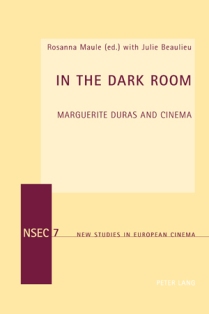
MAULE, Rosanna et Julie BEAULIEU (dir.), In the Dark Room. Marguerite Duras and Cinema, Oxford / Bern / Berlin / Bruxelles / Frankfurt am Main / New York / Wien, Peter Lang (New Studies in European Cinema), 2009, 382 p.
ISBN 978-3-03911-354-5
RÉSUMÉ
This book examines Duras's contribution to contemporary cinema. The'dark room' in the collection's title refers to one of Duras'smetaphors for the writing process, la chambre noire, as thesolitary space of literary creation, the place where she struggles toproject her 'internal shadow' onto the blank page. The dark room isalso a metaphor for the film theater and, by extension, for the filmicexperience. Duras rejected conventional forms of cinematic address thatencourage the spectator to develop a positive identification with thefilm's diegesis and narrative. Her films create unusual rapportsbetween image and sound, diegetic and extra-diegetic elements, andtextual and intertextual dimensions of cinematic representation. Indoing so, they allow the film spectator to establish new connectionswith the screen.
This collection focuses on the aesthetic,conceptual, and political challenges involved in Duras's innovativeapproach to cinematic representation, from an interdisciplinarperspective including film and literary theory, psychoanalyticanalysis, music theory, gender studies, and post-colonial criticism.The book opens with a theoretical introduction to Duras's cinematicpractice and its peculiar position in contemporary cinema andcontemporary film theory and is divided into five parts, each onedevoted to a specific aspect of Duras's films: the interaction betweenliterature and cinema (Part One); the reconfiguration of the cinematicgaze (Part Two) and of the image/sound relation (Part Three); therepresentation of history and memory (Part Four) and of culturalidentity (Part Five).
TABLE DES MATIÈRES
Foreword by Annette Förster - Rosanna Maule: Introduction: Marguerite Duras, la grande imagière - Madeleine Borgomano: The Image of Cinema in The Sea Wall -Catherine Dhavernas: Cinema and the Destruction of the Text in the Workof Marguerite Duras - Cécile Hanania: Once Upon a Time in Hollywood:Cinematic References in Marguerite Duras's Texts - Julie Beaulieu: ThePoetics of Cinematic Writing: Marguerite Duras and Maya Deren -Michelle Royer: Writing, the Writing Self and the Cinema of MargueriteDuras - Bruno Lessard: 'Disparaître, dit-elle': The Vanishing ofLol V. Stein as (Dis)Embodied Haunting and Invisible Spectacle - TammyA. Kinsey: 'You Saw Nothing': Duras's Cinematic Language - Dong Liang:Marguerite Duras's Aural World: A Study of the Mise en son of India Song -Lynsey Russell-Watts: Analysing Sound and Voice: Refiguring Approachesto the Films of the 'Indian Cycle' - Sandy Flitterman-Lewis: Nevers, mon souvenir: Marguerite Duras, History, and the Secret Heart of Hiroshima mon amour - Thomas Stubblefield: Love and the Burden of Memory in Duras's Ten-Thirty on a Summer Night and Moderato Cantabile - Alwin Baum: Le Ravissement de l'autre: Subjective Exile and Semiotic Subversion in Duras's Écriture filmique - Muriel Walker: Taboo Love between Text and Image in the Works of Marguerite Duras and Assia Djebar.
BIOGRAPHIE
Rosanna Maule is Associate Professor of Film Studies at the MelHoppenheim School of Cinema, Concordia University, Montreal (Canada).She is the author of Beyond Auteurism: New Directions in Authorial Film Practices in France, Italy, and Spain since the 1980s (2008) and the editor of special issues of Cinema & Cie, Framework, and Cinémas on early cinema, as well as of several articles published in books and film journals.
Julie Beaulieu is a SSHRC Postdoctoral Fellow in the Department of FilmStudies at Concordia University, Montreal. She wrote a dissertation onMarguerite Duras's text, theatre, and film ('L'Entrécriture dansl'oeuvre de Marguerite Duras. Texte, théâtre, film', Université deMontréal, 2007), and has authored several articles on women'sliterature and cinema.