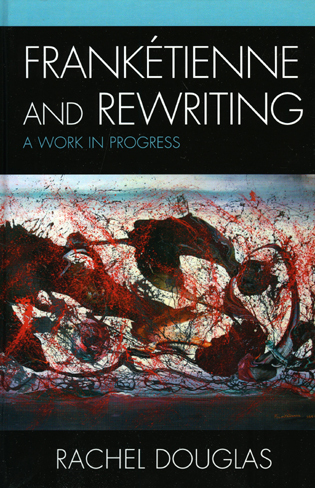
Rachel Douglas, Frankétienne and Rewriting: A Work in Progress
Lexington Books, 200, 206 p
- Isbn 13: 978-0-7391-2565-6 •
Présentation de l'éditeur:
In Frankétienne and Rewriting, Rachel Douglas introduces thework of important Haitian writer Frankétienne through the prism of hisnear-obsessive practice of rewriting. This book offers an overview ofhow the defining aesthetic and thematic components of Frankétienne'smajor works have emerged over the course of his forty-year writingcareer. It reveals the marked development of key notions guiding hisliterary creation since the 1960s, and it demonstrates that rewritingillustrates the central aesthetic of the Spiral, which has alwaysshaped his oeuvre. It is, the book argues, the constantly movingform of the Spiral that Frankétienne explores through his constantreworking of his previously written texts. “Rewriting” in the contextof critical work on Caribbean literature has tended to be used todiscuss revisionism from a variety of postcolonial perspectives, such“rewriting history” or “rewriting canonical texts”. Focusingspecifically on Frankétienne, the book addresses the widespreadpractice of Caribbean writers rewriting their own literary works. Frankétienne and Rewritingoffers theoretical considerations to postcolonial studies onintersections between “literariness” and the material, arguing thatliterary characteristics in Frankétienne connect with changingpolitical, social, economic, and cultural circumstances in the Haiti herewrites.
Rachel Douglas is lecturer in Francophone postcolonial studies at the University of Liverpool
Sommaire:
- Introduction
- The Birth and Continuation of a Practice of Rewriting: Dézafi (1975) – Les Affres d'un défi (1979) – Dezafi (2002)
- Renewing the First Works: Mûr à crever (1968) – Mûr à crever (1995); Ultravocal (1972) – Ultravocal (1995)
Representations of Cannibals: L'Oiseau schizophone (1993) – Les Métamorphoses de l'oiseau schizophone (1996-7)
Processes of Rewriting Exemplified: L'Oiseau schizophone (1993) – Les Métamorphoses de l'oiseau schizophone (1996-7)
Conclusion
"Rachel Douglas' timely study offers remarkably insightful close readings of a writer who has for too long remained unknown to all but a few specialists. Moving decisively beyond earlier models of genetic criticism, Douglas' striking proposition is to analyze 'rewriting' as a primary dimension of Frankétienne's literary productivity. Under Douglas' thoughtful gaze, Spiralism stands revealed as a literature in perpetual movement and self-refashioning, one of outrageous invention and exuberant expressivity that alone has the imaginative resources to articulate the unfathomable terror and beauty of Haitian modernity."—Nick Nesbitt, Senior Lecturer in French, School of Language and Literature at the University of Aberdeen
"An assured and lively study of a neglected writer. Douglas breaks new ground in her analysis of the role of rewriting in Frankétienne's work; her book marks an important contribution to francophone postcolonial studies, and will be of significant interest to scholars of Caribbean literature in the broadest sense."—Maeve McCusker, Senior Lecturer in French Studies and Chair of the Postcolonial Research Forum at Queens University Belfast