Fabula, la recherche en littérature (actu)

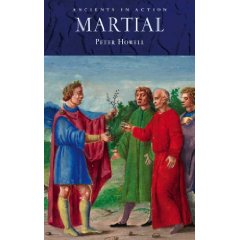
P. Howell, Martial

Parution livre

Information publiée le mardi 24 mars 2009 par Frédérique Fleck


_blank

Peter Howell, Martial, London: Duckworth, coll. "Ancients in Action", 2009. 128 pages.

  • ISBN 9781853997020
  • £11.99

Recension par Shannon N. Byrne (Xavier University) dans Bryn Mawr Classical Review 2009.10.18


Présentation de l'éditeur:

Martial (Marcus Valerius Martialis) was a Spanish writer who lived in Rome in the second half of the first century AD. He wrote only in the genre of epigram, invented by the Greeks, which he chose because of his dislike of all that was pretentious and escapist in contemporary literature, where stale mythological topics were regarded as both ‘elevated' and, in times of political danger, safe. His own boundless interest in the life he saw around him in Rome, and his sense of humour, led him to prefer to express himself in short and highly polished poems. He brought the genre to such a pitch of perfection that his work has defined it for subsequent authors. Although only a limited number of his own epigrams conform to the dictionary definition as ‘a short poem ending in a witty turn of thought', their effectiveness has shaped this definition. This book tells what we know about the man's commonsense attitude to life, and his hatred of hypocrisy and malice. It assesses his debt to literary tradition and the astonishing influence he had on later writers.

Peter Howell was Senior Lecturer in the Department of Classics, Royal Holloway, University of London until his retirement in 1999. He is the author of A Commentary on Book I of the Epigrams of Martial (1980) and Martial: The Epigrams, Book V (1995).


Url de référence :
http://www.ducknet.co.uk/academic/title.php?titleissue_id=903


Derniers ouvrages parus :

Lexique nomade

A. Cousin de Ravel, Quignard, Maître de lecture. Lire, vivre, écrire

P. Engel, Les Lois de l'esprit. Julien Benda ou la raison

M. Crouzet, M. Myself ou La Vie de Stendhal (nouvelle version)

Laurence Brogniez (dir.), Écrits voyageurs. Les artistes et l'ailleurs

O. Biaggini, B. Milland-Bove (dir.), Miracles d'un autre genre  

Sévigné, Lettres de l'année 1671

A. Pope & J. Swift, Pensées sur différents sujets

H. Melville, Le Marchand de paratonnerres, suivi de La Véranda

Le Dit des Heiké

S. Kierkegaard, La Crise et une crise dans la vie d'une actrice

E. Maigret et M. Stefanelli (dir.), La Bande dessinée : une médiaculture

I. Raynauld, Lire et écrire un scénario - Le Scénario de film comme texte

J.-F. Bédia, Les Ecritures africaines face à la logique actuelle du comparatisme

Eusèbe de Césarée, Histoire ecclésiastique. Commentaire - Tome I : Études d'introduction

P. Engel, Les lois de l'esprit, Julien Benda ou la raison  

P. E. Fobah, Introduction à une poétique et une stylistique de la littérature africaine

M.-C. Alexandrine-Sinapah, Itinéraire d'un esclave-poète à Cuba - Juan Francisco Manzano (1797-1854) entre littérature et histoire

Cl. Launchbury, Music, Poetry, Propaganda. Constructing French Cultural Soundscapes at the BBC during the Second World War 

O. Rosenthal, Ils ne sont pour rien dans mes larmes

A. Alciato, Il libro degli Emblemi, secondo le edizioni del 1531 e del 1534

Marc Azéma, La Préhistoire du cinéma

J. Milly, Au seuil de l'image

I. Mons, Lou Andreas-Salomé. En toute liberté

N. Redouane, Lecture(s) de Rachid Mimouni

Fil d'informations RSS Fil d'information RSS   Fabula sur Facebook Fabula sur Facebook   Fabula sur Twitter Fabula sur Twitter