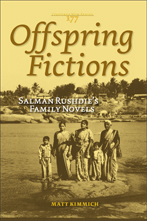
Matt KIMMICH, Offspring Fictions. Salman Rushdie's Family Novels.
Amsterdam/New York, NY: Rodopi, coll. "Costerus" (NS) n° 177, 2008, XI-265 p
- Isbn 13 (ean): 978-90-420-2490-8
Présentation de l'éditeur
Offspring Fictions: Salman Rushdie's Family Novels is the first book-length study that examines families and especially the parent-child relationship in Rushdie's core works. It argues that Sigmund Freud's concept of the family and the author's variations thereon are central to a full understanding of the four novels Midnight's Children, Shame, the controversial The Satanic Verses and The Moor's Last Sigh, a quasi-sequel to Rushdie's first success. Through close readings that make use of a variety of critical approaches, Offspring Fictions provides a sustained examination of how the parents and children that people Rushdie's fictions reflect the larger issues his work is concerned with: nationalism, religion, history and authorship. Aimed primarily at academics and students, but also of interest to the general reader, Offspring Fictions provides a clear and insightful analysis of Rushdie's family tetralogy.
Table
Acknowledgements
Rushdie's Tetralogy
Introduction
Chapter 1: Reading the Novels
Midnight's Children
Chapter 2: The Child Is Father of the Man: Creating Progeny in Midnight's Children
Chapter 3: Days Full of Potential Mothers and Possible Fathers: Saleem Sinai's Multiple Family Romances
Chapter 4: “The Mother-Goddess In Her Most Terrible Aspect”: The Murder of Childhood and Dialogue
Shame
Chapter 5: Sins of the Parents: Monstrous Mothers and Absent Fathers
Chapter 6: “Discrete Parameters of a Family Squabble”: Family Antagonisms
The Satanic Verses
Chapter 7: Absent Fathers and Fallen Sons: The Satanic Verses
Chapter 8: “Pleasechu Meechu, Hopeyu Guessma Nayym”: Giving a Voice to Satanic Doubt
The Moor's Last Sigh
Chapter 9: Uprooting the Family Tree: The Moor's Last Sigh
Chapter 10: Conflicting Parents, Contesting Authors: Who Writes the Moor?
Chapter 11: From Ganesh to Dumbo: The First and the Last of the Family Novels
Select Bibliography
Index