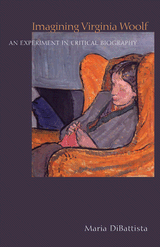
MariaDiBattista
Imagining Virginia Woolf: An Experiment inCritical Biography
Princeton University Press, 2009, 208 pages
ISBN13: 978-0-691-13812-1
Parcourir cet ouvrage (Amazon)
Présentation de l'éditeur:
Where otherworks of literary criticism are absorbed with the question--How to read abook?--Imagining Virginia Woolf asks a slightly different but more intriguingone: how does one read an author? Maria DiBattista answers this by undertakingan experiment in critical biography. The subject of this work is not VirginiaWoolf, the person who wrote the novels, criticism, letters, and famous diary,but a different being altogether, someone or something Maria DiBattistaidentifies as "the figment of the author." This is the Virginia Woolfwho lives intermittently in the pages of her writings and in the imagination ofher readers. Drawing on Woolf's own extensive remarks on the pleasures andperils of reading, DiBattista argues that reading Woolf, in fact reading anyauthor, involves an encounter with this imaginative figment, whose distinct,stylistic traits combine to produce that beguiling phantom--the literarypersonality.
DiBattistareveals a writer who possessed not a single personality, but a cluster ofdistinct, yet complementary identities: the Sibyl of Bloomsbury, the Author,the Critic, the World Writer, and the Adventurer, the last of which, DiBattistaclaims, unites them all.
ImaginingVirginia Woolf provides an original way of reading, one that captures withvariety and subtlety the personality that exists only in Woolf's works and inthe minds of her readers.
L'auteur
MariaDiBattista is professor of English and comparative literature at Princeton University. Her books include Virginia Woolf'sMajor Novels and Fast-Talking Dames.
Table ofContents:
Acknowledgmentsix
THE DEMONOF READING
Chapter 1. TheFigment of the Author 3
Chapter 2.Personalities 14
WOOLF'SPERSONALITIES
Chapter 3. The Sibyl of the Drawing Room 41
Chapter 4.The Author 64
Chapter 5.The Critic 92
Chapter 6.The World Writer 119
Chapter 7. TheAdventurer 140
EPILOGUE
Chapter 8.Anon Once More 169
Notes 173
Index 191
SubjectAreas:
ComparativeLiterature
BritishLiterature