Fabula, la recherche en littérature (actu)

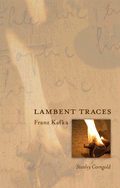
Lambent Traces: Franz Kafka

Parution livre

Information publiée le jeudi 16 septembre 2004 par René Audet


_blank


Stanley Corngold, Lambent Traces: Franz Kafka, Princeton University Press, 2004, 296 p.
ISBN: 0-691-11816-7

On the night of September 22, 1912, Franz Kafka wrote his story "The Judgment," which came out of him "like a regular birth." This act of creation struck him as an unmistakable sign of his literary destiny. Thereafter, the search of many of his characters for the Law, for a home, for artistic fulfillment can be understood as a figure for Kafka's own search to reproduce the ecstasy of a single night.

In Lambent Traces: Franz Kafka, the preeminent American critic and translator of Franz Kafka traces the implications of Kafka's literary breakthrough. Kafka's first concern was not his responsibility to his culture but to his fate as literature, which he pursued by exploring "the limits of the human." At the same time, he kept his transcendental longings sober by noting--with incomparable irony--their virtual impossibility.

At times Kafka's passion for personal transcendence as a writer entered into a torturous and witty conflict with his desire for another sort of transcendence, one driven by a modern Gnosticism. This struggle prompted him continually to scrutinize different kinds of mediation, such as confessional writing, the dream, the media, the idea of marriage, skepticism, asceticism, and the imitation of death. Lambent Traces: Franz Kafka concludes with a reconstruction and critique of the approaches to Kafka by such major critics as Adorno, Gilman, and Deleuze and Guattari..


Derniers ouvrages parus :

Lexique nomade

A. Cousin de Ravel, Quignard, Maître de lecture. Lire, vivre, écrire

P. Engel, Les Lois de l'esprit. Julien Benda ou la raison

M. Crouzet, M. Myself ou La Vie de Stendhal (nouvelle version)

Laurence Brogniez (dir.), Écrits voyageurs. Les artistes et l'ailleurs

O. Biaggini, B. Milland-Bove (dir.), Miracles d'un autre genre  

Sévigné, Lettres de l'année 1671

A. Pope & J. Swift, Pensées sur différents sujets

H. Melville, Le Marchand de paratonnerres, suivi de La Véranda

Le Dit des Heiké

S. Kierkegaard, La Crise et une crise dans la vie d'une actrice

E. Maigret et M. Stefanelli (dir.), La Bande dessinée : une médiaculture

I. Raynauld, Lire et écrire un scénario - Le Scénario de film comme texte

J.-F. Bédia, Les Ecritures africaines face à la logique actuelle du comparatisme

Eusèbe de Césarée, Histoire ecclésiastique. Commentaire - Tome I : Études d'introduction

P. Engel, Les lois de l'esprit, Julien Benda ou la raison  

P. E. Fobah, Introduction à une poétique et une stylistique de la littérature africaine

M.-C. Alexandrine-Sinapah, Itinéraire d'un esclave-poète à Cuba - Juan Francisco Manzano (1797-1854) entre littérature et histoire

Cl. Launchbury, Music, Poetry, Propaganda. Constructing French Cultural Soundscapes at the BBC during the Second World War 

O. Rosenthal, Ils ne sont pour rien dans mes larmes

A. Alciato, Il libro degli Emblemi, secondo le edizioni del 1531 e del 1534

Marc Azéma, La Préhistoire du cinéma

J. Milly, Au seuil de l'image

I. Mons, Lou Andreas-Salomé. En toute liberté

N. Redouane, Lecture(s) de Rachid Mimouni

Fil d'informations RSS Fil d'information RSS   Fabula sur Facebook Fabula sur Facebook   Fabula sur Twitter Fabula sur Twitter