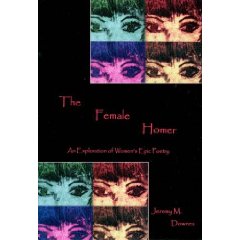
Jeremy M. Downes, The female Homer: an exploration of women's epic poetry. Newark: University of Delaware Press, 2010. 350 p.
- $72.50.
- ISBN 9780874130768.
Recension par Keeley Cathleen Schell (Wheaton College) dans Bryn Mawr Classical Review 2010.11.31.
Présentation de l'éditeur:
The Female Homer opens with simple questions: Are there any women's epic poems? If so, what are the central characteristics of these epics, and how do they relate to the traditional vision of epic poetry as male-authored and masculinist, as powerful and patriarchal? The book explores relations among women's epic poems over a great span—from the ancient Sumerian Descent of Inanna to Rita Dove, from the oral epics of the Russian bylinists to contemporary "language" poets. Through brief, accessible chapters, the book opens up the mythic structure of women's epic, developing its relations with feminism and patriarchy, with religion and democracy, with the personal and the political, with its literary grandmothers and its grandfathers. The Female Homer, though aware of the divergences, focuses on bringing together the strong affinities between these diverse epic voices. In doing so, it charts—for the first time—the otherwise invisible tradition of women's epic.
Jeremy M. Downes is Associate Professor of English at Auburn University.
Table des matières:
For love and glory, by way of a preface
Introduction
Historical overview
The sympathetic magic of genre : hybrids, creoles, mongrels, and contagions
Laundry : cyclical mythic structure in women's epic
Laundry, myth , and modernity
Psyche : internalized mythic structure in women's epic
Oral culture and women's performance
Making it up out of whole cloth : textual textiles and textilist readings of epic
Invisible child : anonymous was a woman and other stories
Tomboy epic : epics of girlhood
Fathers' daughters : against the fathers' amnesia
My mother, myself : symbiotic recursions in women's epic
Exits and entrances : monumental time in womans' epic
Ironing things out : cyclical timing in women's epic
My woman-naming roar : feminist discourse and women's epic
Divine machinery : the gods and religious thought in women's epic
It gets hard core : materialist girls
Mowing the lawn : democratic, inclusive goals in women's epic
Small dynasties : the local, familial, and global in women's epic
The heroic text : poetry as heroic action.