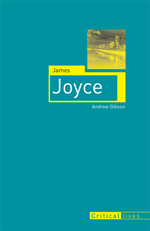
Gibson, Andrew, James Joyce. Introduction by Declan Kiberd. Reaktion Books (Critical Lives), 2006. 192 p.
ISBN: 1-86189-277-2
From Ulysses to Finnegans Wake, James Joyce’s writings rank among the most intimidating works of literature. Unfortunately, many of the books that purport to explain Joyce are equally difficult. The Critical Lives series comes to the rescue with this concise yet deep examination of Joyce’s life and literary accomplishments, an examination that centers on Joyce’s mythical and actual Ireland as the true nucleus of his work.
Andrew Gibson argues here that the most important elements in Joyce’s novels are historically material and specific to Ireland—not, as is assumed, broadly modernist. Taking Joyce “local,” Gibson highlights the historical and political traditions within Joyce’s family and upbringing and then makes the case that Ireland must play a primary role in the study of Joyce. The fall of Charles Stewart Parnell, the collapse of political hope after the Irish nationalist upheavals, the early twentieth-century shift by Irish public activists from political to cultural concerns—all are crucial to Joyce’s literary evolution. Even the author’s move to mainland Europe, asserts Gibson, was actually the continuation of a centuries-old Irish legacy of emigration rather than an abandonment of his native land.
In the thousands, perhaps millions, of words written about Joyce, Ireland often takes a back seat to his formal experimentalism and the modernist project as a whole. Yet here Gibson challenges this conventional portrait of Joyce, demonstrating that the tightest focus—Joyce as an Irishman—yields the clearest picture.