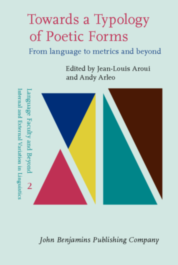
J.-L. Aroui, A. Arleo (dir.), Towards a Typology of Poetic Forms. From Language to Metrics and Beyond
Towards a Typology of Poetic Forms. From language to metrics and beyond
Sous la dierction de Jean-Louis Aroui ( Université Paris 8) et Andy Arleo (Université de Nantes)
Amsterdam: John Benjamins, coll. "Language Faculty and Beyond" n° 2, 2009. xiv-428 p.
- Isbn 13 (ean): 978 90 272 0819 4
- 105€
Présentation de l'éditeur:
Metrics is often defined as a discipline that concerns itself with thestudy of meters. In this volume the term is used in a broader sensethat more or less coincides with the traditional notion of“versification”. Understood this way, metrics is an eminently complexobject that displays variation over time and in space, that concernsforms of a great variety and with different statuses (meters, rhymes,stanzas, prescribed forms, syllabification rules, nursery rhymes,slogans, musical textsetting, ablaut reduplication etc.), and that as acultural manifestation is performed in a variety of ways (sung,chanted, spoken, read) that can have direct consequences on how it isstructured. This profusion of forms is thought to correspond, at thelevel of perception, to a limited number of cognitive mechanisms thatallow us to perceive and to represent regularly iterating forms. Thisvolume proposes a relatively coherent overall vision by distinguishingfour main families of metrical forms, each clearly independent of theothers and amenable to separate typologies.
“There are very few books of high quality in the field of metrical study, and even fewer which bring together leading experts focusing on specific problems of verse- form; this wide-ranging volume is therefore to be warmly welcomed.”
Derek Attridge, University of York
Sommaire (avec résumés des articles sur le site de l'éditeur):
Table of contents
Contributors
Acknowledgments
Introduction: Proposals for metrical typology
Jean-Louis Aroui
Part I. Isochronous metrics
Textsetting as constraint conflict
Bruce Hayes
Comparing musical textsetting in French and in English songs
Francois Dell and John Halle
Bavarian Zwiefache: Investigating the interface between rhythm, metrics and
song
Patrizia Noel Aziz Hanna and Robert Vetterle
Natural Versification in French and German counting-out rhymes
Andreas Dufter and Patrizia Noel Aziz Hanna
Minimal chronometric forms: On the durational metrics of 2-2-stroke groups
Benoît de Cornulier
Symmetry and children's poetry in sign languages
Marion Blondel and Christopher Miller
Part II. Prosodic metrics
Pairs and triplets: A theory of metrical verse
Nigel Fabb and Morris Halle
Generative linguistics and Arabic metrics
Bruno Paoli
On the meter of Middle English alliterative verse
Donka Minkova
The Russian Auden and the Russianness of Auden: Meaning and form in a
translation by Brodsky
Nila Friedberg
Towards a universal definition of the caesura
Marc Dominicy and Mihai Nasta
Metrical alignment
Kristin Hanson
Rephrasing line-end restrictions
Carlos Piera
Part III. Para-metrical phenomena
Pif paf poof: Ablaut reduplication in children's counting-out rhymes
Andy Arleo
The phonology of elision and metrical figures in Italian versification
Oreste Floquet
Part IV. Macrostructural metrics
Convention and parody in the rhyming of Tristan Corbière
Dominique Billy
The metrics of Sephardic song
José Domínguez Caparrós
A rule of metrical uniformity in old Hungarian poetry
Iván Horváth
Metrical structure of the European sonnet
Jean-Louis Aroui
Persons index
Languages index
Subjects index