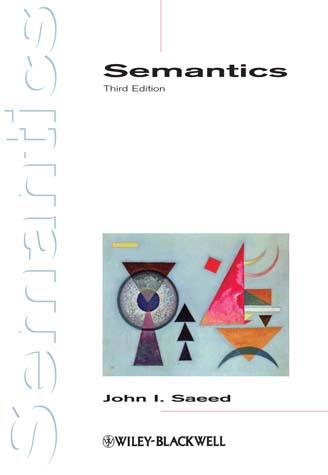
JOHN I. SAEED (Trinity College, Dublin), Semantics (third Edition), Blackwell Publishing, nov. 2008, 480 p.
Isbn 13 (ean): 9781405156394
Présentation de l'éditeur:
The third edition of this popular textbook provides an engaging and accessible introduction to semantics for students new to the field.
Explores the basic concepts and methods of the field and discusses some of the most important contemporary lines of research
Contains new solutions to chapter exercises in order to familiarize the student with the practice of semantic description
Completely revised and updated to reflect recent theoretical developments
Includes new sections on classifiers and noun classes, as well as conceptual integration
John I. Saeed is Associate Professor of Linguistics and Head of the School of Linguistic, Speech and Communication Sciences, Trinity College, University of Dublin. He is the author of several books, including Somali Reference Grammar (second edition, 1993) and Somali (1999).
Sommaire:
List of Figures and Tables
Preface
Abbreviations and Symbols
Part I: Preliminaries
1. Semantics in Linguistics
1.1 Introduction
1.2 Semantics and Semiotics
1.3 Three Challenges in Doing Semantics
1.4 Meeting the Challenges
1.5 Semantics in a Model of Grammar
1.6 Some Important Assumptions
1.7 Summary
Further reading
Exercises
2. Meaning, Thought and Reality
2.1 Introduction
2.2 Reference
2.3 Reference as a Theory of Meaning
2.4 Mental Representations
2.5 Words, Concepts and Thinking
2.6 Summary
Further reading
Exercises
Part II: Semantic Description
3. Word Meaning
3.1 Introduction
3.2 Words and Grammatical Categories
3.3 Words and Lexical Items
3.4 Problems with Pinning Down Word Meaning
3.5 Lexical Relations
3.6 Derivational Relations
3.7 Lexical Universals
3.8 Summary
Further reading
Exercises
4. Sentence Relations and Truth
4.1 Introduction
4.2 Logic and Truth
4.3 Necessary Truth, A Priori Truth and Analyticity
4.4 Entailment
4.5 Presupposition
4.6 Summary
Further reading
Exercises
5. Sentence Semantics 1: Situations
5.1 Introduction
5.2 Classifying Situations
5.3 Modality and Evidentiality
5.4 Summary
Further reading
Exercises
6. Sentence Semantics 2: Participants
6.1 Introduction: Classifying Participants
6.2 Thematic Roles
6.3 Grammatical Relations and Thematic Roles
6.4 Verbs and Thematic Role Grids
6.5 Problems with Thematic Roles
6.6 The Motivation for Identifying Thematic Roles
6.7 Voice
6.8 Classifiers and Noun Classes
6.9 Summary
Further reading
Exercises
7. Context and Inference
7.1 Introduction
7.2 Deixis
7.3 Reference and Context
7.4 Knowledge as Context
7.5 Information Structure
7.6 Inference
7.7 Conversational Implicature
7.8 Summary
Further reading
Exercises
8. Functions of Language: Speech as Action
8.1 Introduction
8.2 Austin's Speech Act Theory
8.3 Categorizing Speech Acts
8.4 Indirect Speech Acts
8.5 Sentence Types
8.6 Summary
Further reading
Exercises
Part III: Theoretical Approaches
9. Meaning Components
9.1 Introduction
9.2 Lexical Relations in CA
9.3 Katz's Semantic Theory
9.4 Grammatical Rules and Semantic Components
9.5 Components and Conflation Patterns
9.6 Jackendoff's Conceptual Structure
9.7 Pustejovsky's Generative Lexicon
9.8 Problems with Components of Meaning
9.9 Summary
Further reading
Exercises
10. Formal Semantics
10.1 Introduction
10.2 Model-Theoretical Semantics
10.3 Translating English into a Logical Metalanguage
10.4 The Semantics of the Logical Metalanguage
10.5 Checking the Truth-Value of Sentences
10.6 Word Meaning: Meaning Postulates
10.7 Natural Language Quantifiers and Higher Order Logic
10.8 Intensionality
10.9 Dynamic Approaches to Discourse
10.10 Summary
Further reading
Exercises
11. Cognitive Semantics
11.1 Introduction
11.2 Metaphor
11.3 Metonymy
11.4 Image Schemas
11.5 Polysemy
11.6 Mental Spaces
11.7 Langacker's Cognitive Grammar
11.8 Summary
Further reading
Exercises
Solutions to Selected Exercises
Bibliography
Index