Fabula, la recherche en littérature (actu)

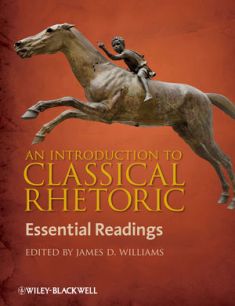
J. D. Williams (éd.), An Introduction to Classical Rhetoric. Essential Readings

Parution livre

Parution : avril 2009.

Information publiée le jeudi 23 avril 2009 par Florian Pennanech


_blank

James D. Williams (éd.), An Introduction to Classical Rhetoric. Essential Readings, Chichester, U.K. ; Malden, MA : Wiley-Blackwell, 2009, 560 p.

  • ISBN-13 : 978-1-4051-5860-2
  • Prix : 66 €

Recension par Brad L. Cook (San Diego State University) dans Bryn Mawr Classical Review 2009.12.37.

Présentation de l'éditeur :

An anthology of primary texts in translation, An Introduction to Classical Rhetoric offers an overview of the social, cultural, and intellectual factors that influenced the development and growth of rhetoric during the classical period.
Uses primary source material to analyze rhetoric from the Sophists through St. Augustine
Provides an in-depth introduction to the period, as well as introductions to each author and each selection
Includes study guides to help students develop multiple perspectives on the material, stimulate critical thinking, and provide starting points for dialogue
Highlights include Gorgias's Palamedes, Antiphon's Truth, Isocrates' Helen, and Plato's Protagoras
Each selection is followed by suggested writing topics and a short list of suggested additional readings. Sommaire :

Acknowledgments

Introduction

Part I: Classical Greek Rhetoric

1. Introduction to Greek Rhetoric

2. Female Voices

3. The Sophists

4. Plato on Philosophy and Rhetoric

5. Aristotle and the Systemization of Rhetoric

Part II: Classical Roman Rhetoric

6. Introduction to Roman Rhetoric and Oratory

7. Cicero and the Latinization of Greek Rhetoric

8. Horace and the Revival of Poetry

9. Quintilian the Educator

10. The End of the Classical Period: Libanius and Augustine

References

Sources

Index

Auteur :

James D. Williams is Professor of Rhetoric & Linguistics and a former Director of the Writing Program at Soka University. He is the author of many books, including The Teacher's Grammar Book (2e, 2005) and Visions and Revisions: Continuity and Change in Rhetoric and Composition (2002).

Lire un extrait (fichier PDF).


Url de référence :
http://eu.wiley.com/WileyCDA/WileyTitle/productCd-1405158603,descCd-description.html


Derniers ouvrages parus :

Lexique nomade

A. Cousin de Ravel, Quignard, Maître de lecture. Lire, vivre, écrire

P. Engel, Les Lois de l'esprit. Julien Benda ou la raison

M. Crouzet, M. Myself ou La Vie de Stendhal (nouvelle version)

Laurence Brogniez (dir.), Écrits voyageurs. Les artistes et l'ailleurs

O. Biaggini, B. Milland-Bove (dir.), Miracles d'un autre genre  

Sévigné, Lettres de l'année 1671

A. Pope & J. Swift, Pensées sur différents sujets

H. Melville, Le Marchand de paratonnerres, suivi de La Véranda

Le Dit des Heiké

S. Kierkegaard, La Crise et une crise dans la vie d'une actrice

E. Maigret et M. Stefanelli (dir.), La Bande dessinée : une médiaculture

I. Raynauld, Lire et écrire un scénario - Le Scénario de film comme texte

J.-F. Bédia, Les Ecritures africaines face à la logique actuelle du comparatisme

Eusèbe de Césarée, Histoire ecclésiastique. Commentaire - Tome I : Études d'introduction

P. Engel, Les lois de l'esprit, Julien Benda ou la raison  

P. E. Fobah, Introduction à une poétique et une stylistique de la littérature africaine

M.-C. Alexandrine-Sinapah, Itinéraire d'un esclave-poète à Cuba - Juan Francisco Manzano (1797-1854) entre littérature et histoire

Cl. Launchbury, Music, Poetry, Propaganda. Constructing French Cultural Soundscapes at the BBC during the Second World War 

O. Rosenthal, Ils ne sont pour rien dans mes larmes

A. Alciato, Il libro degli Emblemi, secondo le edizioni del 1531 e del 1534

Marc Azéma, La Préhistoire du cinéma

J. Milly, Au seuil de l'image

I. Mons, Lou Andreas-Salomé. En toute liberté

N. Redouane, Lecture(s) de Rachid Mimouni

Fil d'informations RSS Fil d'information RSS   Fabula sur Facebook Fabula sur Facebook   Fabula sur Twitter Fabula sur Twitter