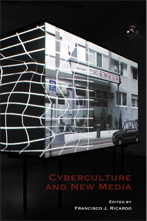
Cyberculture and New Media.
Francisco J. RICARDO (Ed.)
Amsterdam/New York, NY: Rodopi, coll. "At the Interface/Probing the Boundaries" n° 56, 2009, VII-312 p.
Isbn 13 (ean): 978-90-420-2518-9
Présentation de l'éditeur
In the extension of digital media fromoptional means to central site of activity, the domains of language, art,learning, play, film, and politics have been subject to radicalreconfigurations as mediating structures. This book examines how this changed relationshiphas in each case shaped a new form of discourse between self and culture andillustrates explicitly the character of mediated agency beyond the formalseparateness from lived experience that was once conveniently termed thevirtual and which has come to influence common assumptions about creativeexpression itself.
Table
Preface: ‘Until Something Else' – ATheoretical Introduction
PART 1 The Empirical
Francisco J. RICARDO: Formalisms of DigitalText
Sheizaf RAFAELI, Tsahi HAYAT, Yaron ARIEL: Knowledge Building and Motivations in Wikipedia: Participation as “Ba”
Mahmoud EID: On the Way to theCyber-Arab-Culture: International Communication, Telecommunications Policies,and Democracy
Rita ZALTSMAN: The Challenge of InterculturalElectronic Learning: English as Lingua Franca
PART 2 The Aesthetic
Nicole RIDGWAY and Nathaniel STERN: TheImplicit Body
Leman GIRESUNLU: Cyborg Goddesses: theMainframe Revisited
Maria BÄCKE: De-Colonizing Cyberspace:Post-Colonial Strategies in Cyberfiction
Tony RICHARDS: The Différance Engine:Videogames as Deconstructive Spacetime
Alev ADIL and Steve KENNEDY: Technology onScreen: Projections, Paranoia and Discursive practice
Seppo KUIVAKARI: Desistant Media
List of Contributors
Index
L'auteur
Francisco J. Ricardo is Research Associate atthe University Professors Program and co-director of the Digital Video ResearchArchive at Boston University, and teaches digital media theory at the Rhode Island School of Design. Hehas degrees from Harvard University and Boston University. His research examines historical, conceptual, and computationalintersections between contemporary and new media art.