Fabula, la recherche en littérature (actu)

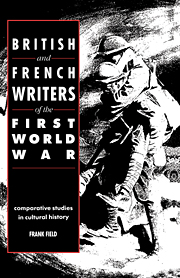
F. Field, British and French Writers of the First World War. Comparative Studies in Cultural History

Parution livre

Information publiée le samedi 19 juillet 2008 par Gabriel Marcoux-Chabot (source : Site web de la maison d'édition)


_blank

FIELD, Frank, British and French Writers of the First World War. Comparative Studies in Cultural History, New York, Cambridge University Press, 2008, 292 p.
ISBN 9780521069106

RÉSUMÉ

The First World War dealt a profound shock to European society. In this original and stimulating book, the historian Frank Field looks at the experiences of France and Britain during the war years as revealed in the work of some of their most prominent writers responding to the unfolding catastrophe. Brooke, Wells, Shaw, Kipling, Lawrence, Owen and Rosenberg are set alongside Jaurès, Barrès, Maurras, Péguy, Psichari and Rolland, as case studies of the war's impact on intellectual life in their respective countries. The comparative perspective reveals deep differences between the French and the British experience, and yet a shared ordeal marked by the terrible ironies attendant on the shattering of common ideals. Literary images of war as a purification rite were effaced by the bloody realities of the conflict and the prophecies of writers who came to feel increasingly distanced from the essential innocence of the world before 1914 took on a new tone, grimly apocalyptic or bitterly disillusioned.

TABLE DES MATIÈRES

Introduction; Part I. Notre Patrie: 1. Jean Jaurès: the fight against war; 2. Maurice Barrès, Charles Maurras, Charles Péguy: the defence of France; 3. Ernest Psichari: the call of arms; Part II. For ever England: 4. Rupert Brooke: the soldier; 5. H. G. Wells, Bernard Shaw: prophecy and hearbreak; 6. Rudyard Kipling: stoicism and empire; Part III. The Decline of the West: 7. Romain Rolland: above the battle; 8. D. H. Lawrence: nightmare and escape; 9. Isaac Rosenberg, Wilfred Owen: anthems for doomed youth; Epilogue.


Url de référence :
http://www.cambridge.org/us/catalogue/catalogue.asp?isbn=9780521069106


Derniers ouvrages parus :

Lexique nomade

A. Cousin de Ravel, Quignard, Maître de lecture. Lire, vivre, écrire

P. Engel, Les Lois de l'esprit. Julien Benda ou la raison

Laurence Brogniez (dir.), Écrits voyageurs. Les artistes et l'ailleurs

O. Biaggini, B. Milland-Bove (dir.), Miracles d'un autre genre  

Sévigné, Lettres de l'année 1671

A. Pope & J. Swift, Pensées sur différents sujets

H. Melville, Le Marchand de paratonnerres, suivi de La Véranda

Le Dit des Heiké

S. Kierkegaard, La Crise et une crise dans la vie d'une actrice

E. Maigret et M. Stefanelli (dir.), La Bande dessinée : une médiaculture

I. Raynauld, Lire et écrire un scénario - Le Scénario de film comme texte

J.-F. Bédia, Les Ecritures africaines face à la logique actuelle du comparatisme

Eusèbe de Césarée, Histoire ecclésiastique. Commentaire - Tome I : Études d'introduction

P. Engel, Les lois de l'esprit, Julien Benda ou la raison  

P. E. Fobah, Introduction à une poétique et une stylistique de la littérature africaine

M.-C. Alexandrine-Sinapah, Itinéraire d'un esclave-poète à Cuba - Juan Francisco Manzano (1797-1854) entre littérature et histoire

Cl. Launchbury, Music, Poetry, Propaganda. Constructing French Cultural Soundscapes at the BBC during the Second World War 

O. Rosenthal, Ils ne sont pour rien dans mes larmes

A. Alciato, Il libro degli Emblemi, secondo le edizioni del 1531 e del 1534

Marc Azéma, La Préhistoire du cinéma

J. Milly, Au seuil de l'image

I. Mons, Lou Andreas-Salomé. En toute liberté

N. Redouane, Lecture(s) de Rachid Mimouni

Chr. Martin (dir.), Fictions de l'origine (1650-1800)

Fil d'informations RSS Fil d'information RSS   Fabula sur Facebook Fabula sur Facebook   Fabula sur Twitter Fabula sur Twitter