Fabula, la recherche en littérature (actu)

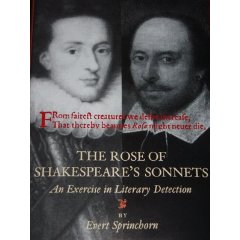
E. Sprinchorn, The Rose of Shakespeare's Sonnets: An Exercise in Literary Detection

Parution livre

Information publiée le mardi 28 avril 2009 par Marc Escola


_blank

Evert Sprinchorn's The Rose of Shakespeare's Sonnets: An Exercise in Literary Detection brings new material to bear on all the controversial issues, such as the date of composition and the identity of the young man to whom the majority of the sonnets are addressed. Although Shakespeare promised to give the young man immortality, he has disappeared into the mists of history. However, he is not as elusive as the commentators have made us believe. He also won the attentions of another poet, who almost certainly was George Chapman, the highly esteemed translator of Homer. The obvious place to look for the young man is in Chapman's poetry. Oddly, the investigators have never followed up this attractive lead. Once the young man has been given a name and a face, the sonnet sequence can be read as an exciting narrative, set in the homoerotic court of King James I, and as an extraordinary confession, centering on the conflict between different kinds of love. Evert Sprinchorn is professor emeritus of drama at Vassar College. Among his publications are Strindberg as Dramatist, translations of Strindberg's plays and autobiographical writings, editions of Ibsen's letters and Wagner's prose works, essays on Shakespeare, and an interpretation of Joyce's Portrait of the Artist as a Young Man. Most recently he has co-edited with Gabrielle Cody The Columbia Encyclopedia of Modern Drama.

Hardcover Publisher: Evert Sprinchorn/Printer's Press; 1st edition edition (2008) ISBN-10: 0615237592 ISBN-13: 978-0615237596 *  *  *

On peut lire sur le site nonfiction.fr un article en français sur cet ouvrage:

"Le Masque de fer de la littérature anglaise", par V. Giroud.


Derniers ouvrages parus :

Gérard de Nerval, Choix des poésies de Ronsard, Du Bellay, Baïf, Belleau, Du Bartas, Chassignet, Desportes, Régnier (éd. E. Buron / J.-N. Illouz)

Lexique nomade

A. Cousin de Ravel, Quignard, Maître de lecture. Lire, vivre, écrire

P. Engel, Les Lois de l'esprit. Julien Benda ou la raison

Laurence Brogniez (dir.), Écrits voyageurs. Les artistes et l'ailleurs

O. Biaggini, B. Milland-Bove (dir.), Miracles d'un autre genre  

Sévigné, Lettres de l'année 1671

A. Pope & J. Swift, Pensées sur différents sujets

H. Melville, Le Marchand de paratonnerres, suivi de La Véranda

Le Dit des Heiké

S. Kierkegaard, La Crise et une crise dans la vie d'une actrice

E. Maigret et M. Stefanelli (dir.), La Bande dessinée : une médiaculture

I. Raynauld, Lire et écrire un scénario - Le Scénario de film comme texte

J.-F. Bédia, Les Ecritures africaines face à la logique actuelle du comparatisme

Eusèbe de Césarée, Histoire ecclésiastique. Commentaire - Tome I : Études d'introduction

P. Engel, Les lois de l'esprit, Julien Benda ou la raison  

P. E. Fobah, Introduction à une poétique et une stylistique de la littérature africaine

M.-C. Alexandrine-Sinapah, Itinéraire d'un esclave-poète à Cuba - Juan Francisco Manzano (1797-1854) entre littérature et histoire

Cl. Launchbury, Music, Poetry, Propaganda. Constructing French Cultural Soundscapes at the BBC during the Second World War 

O. Rosenthal, Ils ne sont pour rien dans mes larmes

A. Alciato, Il libro degli Emblemi, secondo le edizioni del 1531 e del 1534

Marc Azéma, La Préhistoire du cinéma

J. Milly, Au seuil de l'image

I. Mons, Lou Andreas-Salomé. En toute liberté

N. Redouane, Lecture(s) de Rachid Mimouni

Fil d'informations RSS Fil d'information RSS   Fabula sur Facebook Fabula sur Facebook   Fabula sur Twitter Fabula sur Twitter