Compte rendu publié dans Acta fabula : "Quand la fiction zolienne se mêle d'anarchie : représentations & narration" par Marjorie Rousseau.
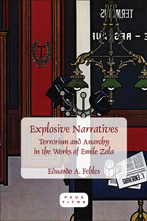
Eduardo A. Febles, Explosive Narratives: Terrorism and Anarchy in the Works of Emile Zola
Amsterdam : Rodopi, coll. "Faux titre", 2010.
EAN 9789042030640
198 p.
Prix 40EUR
Présentation de l'éditeur :
Explosive Narratives: Terrorism and Anarchy in the Works of Emile Zola explores the genealogy of modern day terrorism through a close study of the anarchist figure in three of Emile Zola's novels: Germinal, Paris, and Travail. The study links the crisis of representation registered at the end of the 19th century with the rise of terrorism embodied in the bomb-throwing anarchist. It thereby traces Zola's evolving thoughts on anarchy from the terrorist to the humanitarian reformer, from class warfare to a peaceful artisan commune, from a naturalist depiction of an elusive reality to a utopian writing fleeing the contingencies of the historical. The volume brings together aesthetic, political, urban, and scientific debates of Belle Epoque France and it will thus be of great interest not only to Zola scholars, but also to students of late 19th-century politics and art.
Table of Contents
Acknowledgments
Introduction: Anarchy, Entropy, Naturalism
Anarchy
Entropy
Naturalism
Chapter 1: Souvarine's Vanishing Act: The Effacement of Anarchy in Germinal
The Ambiguous Politics of Germinal
The Resurgence of Anarchy from the Underground Mine
Undermining Narratives: The Sub-text of Anarchy
Chapter 2: Anarchy as Narrative Capital: The Emplotment of Terrorism in Paris
The Political Discourse in Paris
Anarchy as Narrative Capital
Towards Utopia: Taking the Bite Out of Anarchy
Chapter 3: The Anarchic Commune as World's Fair in Travail
Ideological Welding: Fourier and Anarchism
Revolutionary Rape as Entropic Heat Death
Beyond Narrative Entropy: Utopia
The Anarchic Commune as World's Fair
Epilogue: Zola's Dream
Bibliography
Index