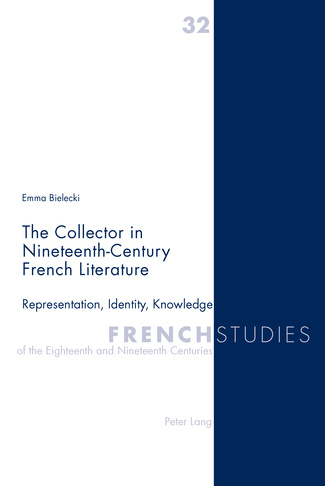
E. Bielecki, The Collector in Nineteenth-Century French Literature. Representation, Identity, Knowledge
Emma Bielecki, The Collector in Nineteenth-Century French Literature. Representation, Identity, Knowledge
Oxford : Peter Lang, coll. "French Studies of the Eighteenth and Nineteenth Centuries", 2012,
242 p.
EAN 9783034307574.
Prix 42.80EUR
Présentation de l'éditeur :
The collector was one of the archetypal figures of the nineteenth-century French cultural imagination. During the July Monarchy (1830-48) a new culture of collecting emerged, which continued to develop over the course of the century and which attracted the attention of a wide range of social commentators and writers. From the sketch-writing of the 1830s to the late nineteenth-century decadent fictions of Jean Lorrain, from Balzac’s Cousin Pons to Proust’s Charles Swann, the literature of the period abounds in examples of men (and occasionally women) afflicted with what the Larousse Grand Dictionnaire called in 1869 ‘la collectionnomanie’.
This book examines these representations of the collector. It shows that woven into them are fundamental anxieties generated by the experience of modernity, involving the nature of identity and selfhood, the relentless accumulation of commodities in a capitalist system of production and the (in)ability of language to translate experience accurately.
Contents:
The Physiology of the Collector – Of Money and Museums: Le Cousin Pons and the Death of the Collector – Collecting the Self – (Re)Collecting the Past – The Poverty of Taxonomy – To Create or to Collect?
Emma Bielecki teaches modern French literature at the University of Oxford. She holds an MA in French Studies and an MA in European History from University College London and was awarded her PhD by King’s College London for a thesis on representations of the collector in French literature from Balzac to Proust.