Winner of the Conington Prize 2008:
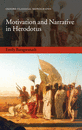
Emily Baragwanath, Motivation and Narrative in Herodotus, Oxford/New York: Oxford University Press, coll. "Oxford Classical Monographs", 2008. xi, 374 pages.
- ISBN 9780199231294.
- $130.00.
Recension par Michael A. Flower (Princeton University) dans Bryn Mawr Classical Review 2009.07.35.
Extraits en ligne sur books.google et sur amazon.fr.
Présentation de l'éditeur:
*Illustrates and analyses Herodotus' techniques for representing motivation overa wide selection of his narratives
* Offers amethodology for reading the Histories more generally
* All Greekis translated, so the text is accessible to all readers with an interest inthis great ancient historian
In his extraordinary story of the defence of Greeceagainst the Persian invasions of 490-480 BC Herodotus sought to communicate notonly what happened, but also the background of thoughts and perceptions thatshaped those events and became critical to their interpretation afterwards.Much as the contemporary sophists strove to discover truth about the invisible,Herodotus was acutely concerned to uncover hidden human motivations, whosedepiction was vital to his project of recounting and explaining the past. EmilyBaragwanath explores the sophisticated narrative techniques with whichHerodotus represented this most elusive variety of historical knowledge. Thushe was able to tell a lucid story of the past while nonetheless exposing themethodological and epistemological challenges it presented. Baragwanathillustrates and analyses a range of these techniques over the course of a wideselection of Herodotus' most intriguing narratives - from those on Atheniandemocracy and tyranny to Leonidas and Thermopylae - andthus supplies a method for reading the Histories more generally.
Emily Baragwanath, Assistant Professor in theDepartment of Classics, University of North Carolina, Chapel Hill
Readership: Scholars and students of classics, ancientliterature, ancient history, literary theory.
Table des matières:
1. The Histories, Plutarch, and reader response
2. The Homeric background
3. Constructions of motives and the historian'spersona
4. Problematized motivation in the Samian and Persianlogoi (Book III)
5. For better, for worse . . .: motivation in theAthenian logoi (Books I and VI)
6. `For freedom's sake . . .': motivation in theIonian Revolt (Books V-VI)
7. To medize or not to medize . . .: compulsion andnegative motives (Books VII-IX)
8. Xerxes: motivation and explanation (Books VII-IX)
9. Themistocles: constructions of motivation (BooksVII-IX)
Epilogue