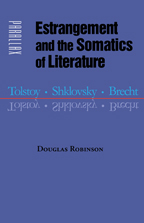
Douglas ROBINSON, Estrangement and the Somatics of Literature. Tolstoy, Shklovsky, Brecht
Baltimore, Johns Hopkins University Press (Parallax : Re-visions of Culture and Society), 2008, 344 p.
EAN : 9780801887963
RÉSUMÉ
Drawing together the estrangement theories of Viktor Shklovsky and Bertolt Brecht with Leo Tolstoy's theory of infection, Douglas Robinson studies the ways in which shared evaluative affect regulates both literary familiarity — convention and tradition — and modern strategies of alienation, depersonalization, and malaise. This book begins with two assumptions, both taken from Tolstoy's late aesthetic treatise What Is Art ? (1898): that there is a malaise in culture, and that literature's power to "infect" readers with the moral values of the author is a possible cure for this malaise. Exploring these ideas of estrangement within the contexts of earlier, contemporary, and later critical theory, Robinson argues that Shklovsky and Brecht follow Tolstoy in their efforts to fight depersonalization by imbuing readers with the transformative guidance of collectivized feeling. Robinson's somatic approach to literature offers a powerful alternative to depersonalizing structuralist and poststructuralist theorization without simply retreating into conservative rejection and reaction. Both a comparative study of Russian and German literary-theoretical history and an insightful examination of the somatics of literature, this groundbreaking work provides a deeper understanding of how literature affects the reader and offers a new perspective on present-day problems in poststructuralist approaches to the human condition.
BIOGRAPHIE
Douglas Robinson is a professor of English at the University of Mississippi.