Fabula, la recherche en littérature (actu)

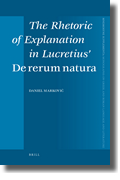
D. Marković, The Rhetoric of Explanation in Lucretius' De rerum natura

Parution livre

Information publiée le lundi 10 novembre 2008 par Bérenger Boulay


_blank

Daniel Marković, The Rhetoric of Explanation in Lucretius' De rerum natura, Leiden, Brill, coll. " Mnemosyne, Supplements" n°294, 2008, xii-180 p.


ISBN :    978 90 04 16796 4
79€

Présentation de l'éditeur:

Alleged incompatibility of Epicurus' philosophy with rhetoric has led modern scholars to isolate rhetorical procedures in Lucretius' De rerum natura and regard them as non-Epicurean, accessory features. This study of Lucretius' rhetorical procedures is based on a wider understanding of the term rhetoric, not limited to the genre of oratory. In a fresh discussion of the questions of provenance and the role of the most important formal procedures of exposition in De rerum natura the author argues that instead of injecting rhetorical strategies from non-Epicurean sources, Lucretius in fact intensified rhetorical elements already present in the work of Epicurus. These elements are used for the purpose of explanation, and function as cognitive and mnemonic aids for the reader.

Daniel Marković, Ph.D. (2006) in Classical Philology, University of Illinois at Urbana-Champaign, is Lecturer in Classics at Temple University, Philadelphia. He has published on Lucretius and on the rhetorical function of hyperbaton and gnome in Greek poetry.


Url de référence :
http://www.brill.nl/default.aspx?partid=210&pid=30757


Derniers ouvrages parus :

O. Biaggini, B. Milland-Bove (dir.), Miracles d'un autre genre  

Sévigné, Lettres de l'année 1671

A. Pope & J. Swift, Pensées sur différents sujets

H. Melville, Le Marchand de paratonnerres, suivi de La Véranda

Le Dit des Heiké

S. Kierkegaard, La Crise et une crise dans la vie d'une actrice

E. Maigret et M. Stefanelli (dir.), La Bande dessinée : une médiaculture

I. Raynauld, Lire et écrire un scénario - Le Scénario de film comme texte

J.-F. Bédia, Les Ecritures africaines face à la logique actuelle du comparatisme

Eusèbe de Césarée, Histoire ecclésiastique. Commentaire - Tome I : Études d'introduction

P. Engel, Les lois de l'esprit, Julien Benda ou la raison  

P. E. Fobah, Introduction à une poétique et une stylistique de la littérature africaine

M.-C. Alexandrine-Sinapah, Itinéraire d'un esclave-poète à Cuba - Juan Francisco Manzano (1797-1854) entre littérature et histoire

Cl. Launchbury, Music, Poetry, Propaganda. Constructing French Cultural Soundscapes at the BBC during the Second World War 

O. Rosenthal, Ils ne sont pour rien dans mes larmes

A. Alciato, Il libro degli Emblemi, secondo le edizioni del 1531 e del 1534

Marc Azéma, La Préhistoire du cinéma

J. Milly, Au seuil de l'image

I. Mons, Lou Andreas-Salomé. En toute liberté

N. Redouane, Lecture(s) de Rachid Mimouni

Chr. Martin (dir.), Fictions de l'origine (1650-1800)

D. Brooks, The Sons of Clovis : Ern Malley, Adoré Floupette and a Secret History of Australian Poetry

Jean Richepin, Truandailles

C. Meyer-Plantureux, Romain Rolland - Théâtre et engagement

C. Aliberti, Du spasme existentiel à la quête de rédemption

Fil d'informations RSS Fil d'information RSS   Fabula sur Facebook Fabula sur Facebook   Fabula sur Twitter Fabula sur Twitter