Fabula, la recherche en littérature (actu)

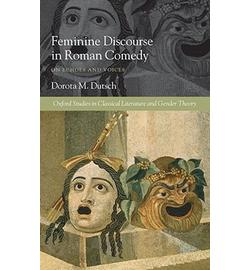
D. M. Dutsch, Feminine Discourse in Roman Comedy: On Echoes and Voices

Parution livre

Information publiée le vendredi 24 avril 2009 par Frédérique Fleck (source : BMCR)


_blank


Dorota M. Dutsch, Feminine Discourse in Roman Comedy: On Echoes and Voices, Oxford/New York:  Oxford University Press, coll. "Oxford Studies in Classical Literature and Gender Theory", 2008. xiii, 278 pages. ISBN 9780199533381 $110.00 Recension par Anise K. Strong (Stanford Universit) dans Bryn Mawr Classical Review 2009.04.37.

Présentation de l'éditeur:

As literature written in Latin has almost no female authors, we are dependent on male writers for some understanding of the way women would have spoken. Plautus (3rd to 2nd century BCE) and Terence (2nd century BCE) consistently write particular linguistic features into the lines spoken by their female characters: endearments, soft speech, and incoherent focus on numerous small problems. Dorota M. Dutsch describes the construction of this feminine idiom and asks whether it should be considered as evidence of how Roman women actually spoke.

Dorota M. Dutsch is Assistant Professor in the Department of Classics, University of California, Santa Barbara.

Extraits en ligne sur books.google et sur amazon.com.


Url de référence :
http://www.oup.com/us/catalog/general/subject/ClassicalStudies/ClassicalLanguages/Latin/?view=usa&ci=9780199533381


Derniers ouvrages parus :

O. Biaggini, B. Milland-Bove (dir.), Miracles d'un autre genre  

Sévigné, Lettres de l'année 1671

A. Pope & J. Swift, Pensées sur différents sujets

H. Melville, Le Marchand de paratonnerres, suivi de La Véranda

Le Dit des Heiké

S. Kierkegaard, La Crise et une crise dans la vie d'une actrice

E. Maigret et M. Stefanelli (dir.), La Bande dessinée : une médiaculture

I. Raynauld, Lire et écrire un scénario - Le Scénario de film comme texte

J.-F. Bédia, Les Ecritures africaines face à la logique actuelle du comparatisme

Eusèbe de Césarée, Histoire ecclésiastique. Commentaire - Tome I : Études d'introduction

P. Engel, Les lois de l'esprit, Julien Benda ou la raison  

P. E. Fobah, Introduction à une poétique et une stylistique de la littérature africaine

M.-C. Alexandrine-Sinapah, Itinéraire d'un esclave-poète à Cuba - Juan Francisco Manzano (1797-1854) entre littérature et histoire

Cl. Launchbury, Music, Poetry, Propaganda. Constructing French Cultural Soundscapes at the BBC during the Second World War 

O. Rosenthal, Ils ne sont pour rien dans mes larmes

A. Alciato, Il libro degli Emblemi, secondo le edizioni del 1531 e del 1534

Marc Azéma, La Préhistoire du cinéma

J. Milly, Au seuil de l'image

I. Mons, Lou Andreas-Salomé. En toute liberté

N. Redouane, Lecture(s) de Rachid Mimouni

Chr. Martin (dir.), Fictions de l'origine (1650-1800)

D. Brooks, The Sons of Clovis : Ern Malley, Adoré Floupette and a Secret History of Australian Poetry

Jean Richepin, Truandailles

C. Meyer-Plantureux, Romain Rolland - Théâtre et engagement

C. Aliberti, Du spasme existentiel à la quête de rédemption

Fil d'informations RSS Fil d'information RSS   Fabula sur Facebook Fabula sur Facebook   Fabula sur Twitter Fabula sur Twitter