Fabula, la recherche en littérature (actu)

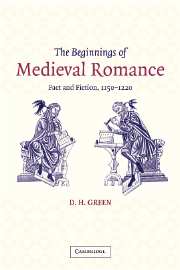
D. H. Green, The Beginnings of Medieval Romance. Fact and Fiction, 1150-1220

Parution livre

Information publiée le samedi 16 février 2008 par Gabriel Marcoux-Chabot (source : Site web de la maison d'édition)


_blank

Dennis H.GREEN, The Beginnings of Medieval Romance. Fact and Fiction, 1150-1220

Cambridge, Cambridge University Press (Cambridge Studies in Medieval Literature, 47), 2008, 308 p.
EAN : 9780521049566


RÉSUMÉ

Up to the twelfth century writing in the western vernaculars dealt almost exclusively with religious, historical and factual themes, all of which were held to convey the truth. The second half of the twelfth century saw the emergence of a new genre, the romance, which was consciously conceived as fictional and therefore allowed largely to break free from traditional presuppositions. Dennis Green explores how and why this happened, and examines this period of crucial importance for the birth of the romance and the genesis of medieval fiction in the vernacular. Although the crucial innovative role of writers in Germany is Green's main concern, he also takes literature in Latin, French and Anglo-Norman into account. This study offers a definition of medieval fictionality in its first formative period in the twelfth century, and underlines the difficulties encountered in finding a place for the fictional romance within earlier literary traditions.


TABLE DES MATIÈRES

Preface; List of abbreviations; 1. Defining twelfth-century fictionality; 2. Vernacular fiction in the twelfth century; 3. Fictive orality; 4. Fiction and Wolfram's Parzival; 5. Fiction and structure; 6. Fiction and history; Notes; Bibliography; Index of names.


Url de référence :
http://www.cambridge.org/uk/catalogue/catalogue.asp?isbn=9780521049566


Derniers ouvrages parus :

O. Biaggini, B. Milland-Bove (dir.), Miracles d'un autre genre  

Sévigné, Lettres de l'année 1671

A. Pope & J. Swift, Pensées sur différents sujets

H. Melville, Le Marchand de paratonnerres, suivi de La Véranda

Le Dit des Heiké

S. Kierkegaard, La Crise et une crise dans la vie d'une actrice

E. Maigret et M. Stefanelli (dir.), La Bande dessinée : une médiaculture

I. Raynauld, Lire et écrire un scénario - Le Scénario de film comme texte

J.-F. Bédia, Les Ecritures africaines face à la logique actuelle du comparatisme

Eusèbe de Césarée, Histoire ecclésiastique. Commentaire - Tome I : Études d'introduction

P. Engel, Les lois de l'esprit, Julien Benda ou la raison  

P. E. Fobah, Introduction à une poétique et une stylistique de la littérature africaine

M.-C. Alexandrine-Sinapah, Itinéraire d'un esclave-poète à Cuba - Juan Francisco Manzano (1797-1854) entre littérature et histoire

Cl. Launchbury, Music, Poetry, Propaganda. Constructing French Cultural Soundscapes at the BBC during the Second World War 

O. Rosenthal, Ils ne sont pour rien dans mes larmes

A. Alciato, Il libro degli Emblemi, secondo le edizioni del 1531 e del 1534

Marc Azéma, La Préhistoire du cinéma

J. Milly, Au seuil de l'image

I. Mons, Lou Andreas-Salomé. En toute liberté

N. Redouane, Lecture(s) de Rachid Mimouni

Chr. Martin (dir.), Fictions de l'origine (1650-1800)

D. Brooks, The Sons of Clovis : Ern Malley, Adoré Floupette and a Secret History of Australian Poetry

Jean Richepin, Truandailles

C. Meyer-Plantureux, Romain Rolland - Théâtre et engagement

C. Aliberti, Du spasme existentiel à la quête de rédemption

Fil d'informations RSS Fil d'information RSS   Fabula sur Facebook Fabula sur Facebook   Fabula sur Twitter Fabula sur Twitter