Fabula, la recherche en littérature (actu)

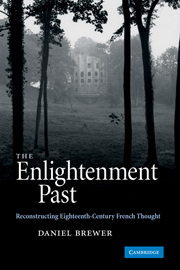
D. Brewer, The Enlightenment Past. Reconstructing Eighteenth-Century French Thought

Parution livre

Information publiée le vendredi 28 mars 2008 par Gabriel Marcoux-Chabot (source : Site web de la maison d'édition)


_blank

Daniel BREWER, The Enlightenment Past. Reconstructing Eighteenth-Century French Thought

Cambridge, Cambridge University Press, 2008, 268 p.
EAN : 9780521879446


RÉSUMÉ

Over the last two hundred years the theories and ideals of the Enlightenment have come to be viewed as the foundation of modern Western political and intellectual culture. Particularly in France they have played a fundamental role in the development of national identity. In a series of richly contextualised readings Daniel Brewer examines the cultural construction of the Enlightenment in France from the eighteenth century to the present day. He examines a range of important Enlightenment texts, explores the ways in which they defined their modernising project, and analyses the cultural and political uses to which they have been put by scholars, writers and intellectuals. This book presents a significant advance in the field of Enlightenment studies, in an important and timely reassessment of the heritage and continued relevance of Enlightenment ideals.


TABLE DES MATIÈRES

1. Producing Enlightenment history; 2. The event of Enlightenment: beginnings; 3. The subject of Enlightenment: constructing philosophers, writing intellectuals; 4. Designing the past: thinking history through Montesquieu; 5. Literature and the making of Revolutionary history; 6. Inventing a literary past; 7. Commemorating Enlightenment: bringing out the dead, belatedly; 8. The Voltaire effect; 9. Reading among the ruins; 10. Epilogue; Bibliography.


Url de référence :
http://www.cambridge.org/us/catalogue/catalogue.asp?isbn=9780521879446


Derniers ouvrages parus :

Le Dit des Heiké

S. Kierkegaard, La Crise et une crise dans la vie d'une actrice

E. Maigret et M. Stefanelli (dir.), La Bande dessinée : une médiaculture

I. Raynauld, Lire et écrire un scénario - Le Scénario de film comme texte

J.-F. Bédia, Les Ecritures africaines face à la logique actuelle du comparatisme

Eusèbe de Césarée, Histoire ecclésiastique. Commentaire - Tome I : Études d'introduction

P. Engel, Les lois de l'esprit, Julien Benda ou la raison  

P. E. Fobah, Introduction à une poétique et une stylistique de la littérature africaine

M.-C. Alexandrine-Sinapah, Itinéraire d'un esclave-poète à Cuba - Juan Francisco Manzano (1797-1854) entre littérature et histoire

Cl. Launchbury, Music, Poetry, Propaganda. Constructing French Cultural Soundscapes at the BBC during the Second World War 

O. Rosenthal, Ils ne sont pour rien dans mes larmes

A. Alciato, Il libro degli Emblemi, secondo le edizioni del 1531 e del 1534

Marc Azéma, La Préhistoire du cinéma

J. Milly, Au seuil de l'image

I. Mons, Lou Andreas-Salomé. En toute liberté

N. Redouane, Lecture(s) de Rachid Mimouni

Chr. Martin (dir.), Fictions de l'origine (1650-1800)

D. Brooks, The Sons of Clovis : Ern Malley, Adoré Floupette and a Secret History of Australian Poetry

Jean Richepin, Truandailles

C. Meyer-Plantureux, Romain Rolland - Théâtre et engagement

C. Aliberti, Du spasme existentiel à la quête de rédemption

M. Kadima-Nzuji, Théâtre et destin national au Congo-Kinshasa - 1965-1990

Jean-Yves Tadié, Le lac inconnu - Entre Proust et Freud

N. Frogneux (dir)., J. Patocka. Liberté, existence et monde commun

Verlaine, Romances sans paroles (éd. Arnaud Bernadet)

Fil d'informations RSS Fil d'information RSS   Fabula sur Facebook Fabula sur Facebook   Fabula sur Twitter Fabula sur Twitter