Fabula, la recherche en littérature (actu)

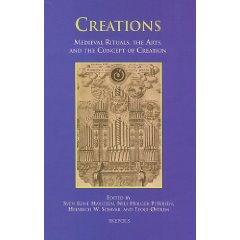
Creations. Medieval Rituals, the Arts, and the Concept of Creation

Parution livre (collectif)

Information publiée le samedi 20 septembre 2008 par Bérenger Boulay


_blank

Sven Rune Havsteen, Nils Holger Petersen, Heinrich W. Schwab, and Eyolf Østrem (eds), Creations. Medieval Rituals, the Arts, and the Concept of Creation, Brepols Publishers, 2007, 269p. 

Isbn (ean13): 978-2-503-52295-1.

Recension de cet ouvrage par Antonella Doninelli dans The Medieval Review (TMR 08.09.17, BMR-L Digest, Vol 20, Issue 27)

Présentation de l'éditeur: 

The meaning of terms like 'creation' or 'to create' - as well as other derivations of such words - range from the traditional theological idea of God creating ex nihilo to a more recent one of artistic creation. This collection of essays written by scholars of music, literature, the visual arts, and theology - which chronologically spans the period from the Carolingians to the twentieth century - explores the complicated relationship between medieval rituals and theology, and the development of an idea of human artistic creation. From the fifteenth century this idea comes to the fore and as late as the early nineteenth century it is occasionally used with reference to Pythagorean cosmology. It may also be directly connected to a medieval ritual heritage. Each study in the volume examines a particular topic concerned with ritual or artistic beginnings, inventions, harmony, disharmony, or representations or celebrations of creation, involving, not least, the interplay of the ideas of God the creator, God as being actively present in the medieval liturgy, God as artist, deus artifex, and, finally, homo creator, man reflecting God in his own (more modest) creativity. The book provides new contributions from the individual scholarly disciplines as well as an impulse to a complex interdisciplinary and large-scale historical construction


Url de référence :
http://www.brepols.net/


Derniers ouvrages parus :

Le Dit des Heiké

S. Kierkegaard, La Crise et une crise dans la vie d'une actrice

E. Maigret et M. Stefanelli (dir.), La Bande dessinée : une médiaculture

I. Raynauld, Lire et écrire un scénario - Le Scénario de film comme texte

J.-F. Bédia, Les Ecritures africaines face à la logique actuelle du comparatisme

Eusèbe de Césarée, Histoire ecclésiastique. Commentaire - Tome I : Études d'introduction

P. Engel, Les lois de l'esprit, Julien Benda ou la raison  

P. E. Fobah, Introduction à une poétique et une stylistique de la littérature africaine

M.-C. Alexandrine-Sinapah, Itinéraire d'un esclave-poète à Cuba - Juan Francisco Manzano (1797-1854) entre littérature et histoire

Cl. Launchbury, Music, Poetry, Propaganda. Constructing French Cultural Soundscapes at the BBC during the Second World War 

O. Rosenthal, Ils ne sont pour rien dans mes larmes

A. Alciato, Il libro degli Emblemi, secondo le edizioni del 1531 e del 1534

Marc Azéma, La Préhistoire du cinéma

J. Milly, Au seuil de l'image

I. Mons, Lou Andreas-Salomé. En toute liberté

N. Redouane, Lecture(s) de Rachid Mimouni

Chr. Martin (dir.), Fictions de l'origine (1650-1800)

D. Brooks, The Sons of Clovis : Ern Malley, Adoré Floupette and a Secret History of Australian Poetry

Jean Richepin, Truandailles

C. Meyer-Plantureux, Romain Rolland - Théâtre et engagement

C. Aliberti, Du spasme existentiel à la quête de rédemption

M. Kadima-Nzuji, Théâtre et destin national au Congo-Kinshasa - 1965-1990

Jean-Yves Tadié, Le lac inconnu - Entre Proust et Freud

N. Frogneux (dir)., J. Patocka. Liberté, existence et monde commun

Verlaine, Romances sans paroles (éd. Arnaud Bernadet)

Fil d'informations RSS Fil d'information RSS   Fabula sur Facebook Fabula sur Facebook   Fabula sur Twitter Fabula sur Twitter