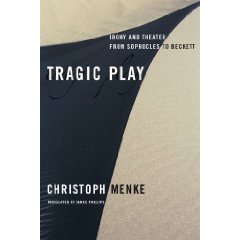
Christoph Menke, Tragic Play: Irony and Theater from Sophoclesto Beckett (translated by James Phillips; first published 2005), New York: Columbia University Press, coll. "Columbia Themes in Philosophy, Social Criticism, and the Arts", 2009. Pp. xi, 232.
- ISBN 9780231145565.
- $55.00.
Recension par Joshua Billings (Merton College, Oxford University) dans Bryn Mawr Classical Review 2009.10.63.
Présentation de l'éditeur:
Tragic Play explores the deep philosophical significance of classic andmodern tragedies in order to cast light on the tragic dimensions ofcontemporary experience. Romanticism, it has often been claimed,brought tragedy to an end, making modernity the age after tragedy.Christoph Menke opposes this modernist prejudice by arguing thattragedy remains alive in the present in the distinctively new form ofthe playful, ironic, and self-consciously performative. Through closereadings of plays by William Shakespeare, Samuel Beckett, HeinerMuller, and Botho Strauss, Menke shows how tragedy re-emerges inmodernity as "tragedy of play." In Hamlet, Endgame, Philoktet, andIthaka, Menke integrates philosophical theory with critical readings toinvestigate shifting terms of judgment, curse, reversal, misfortune,and violence.
L'auteur:
Christoph Menke is professor of philosophy at the University ofFrankfurt am Main. His publications in English include The Sovereigntyof Art, Aesthetic Negativity in Adorno and Derrida, and Reflections ofEquality.
Table des matières:
Part I. The Excess of Judgment: A Reading of Oedipus Tyrannus1. "It was I myself": The Shape of Destiny Acting, Knowing, Judging "In the Manner of Tragedy"2. From Judging to Being Judged: The Story of Oedipus The Juridification of the Oracle Placing a Curse Self-Condemnation The "Curse of the Law"3. Author and Character: Oedipus's Existence Dramatic Existence Transcendental Dramatics Excursus: The Concept of Tragic Irony4. The Violence of Judgment: Oedipus's Experience Philosophy and Tragedy The Objectivity of Judgment Oedipus's Lament Errors Great and Small The Paradox in the Judgment of an Error5. "Learning from Suffering": Tragedy and LifePart II. Theoretical Interlude: The Process of Tragedy6. Toward an Aesthetics of Tragedy: From the Beautiful to Play The Suspension of the Tragic in the Beautiful Contemplation or Reflection Acting Out Action The Freedom of the Actor7. Promise and Impotence of Play Parody of Tragedy and Tragedy of Parody: Romantic Comedy The Untragic Hero: The Dialectical Lehrst?ck Meta-theater, Meta-tragedy Part III. The Tragedy of Play8. Tragedy and Skepticism: On Hamlet Action, Knowledge, Play "Madness" and Irony Dizziness of Reflection: Theater and Tragedy9. Three Sketches: Beckett, M?ller, Strauss The Score of the Feud: Samuel Beckett's Endgame Gladiators of Play: Heiner M?ller's Philoktet Never: Botho Strauss's Ithaka