Fabula, la recherche en littérature (actu)

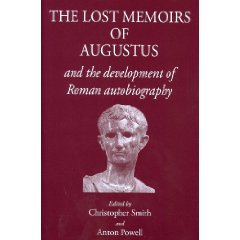
C. Smith and A. Powell (dir.), The lost memoirs of Augustus and the development of Roman autobiography

Parution livre (collectif)

Information publiée le mardi 9 mars 2010 par Frédérique Fleck


_blank

Christopher Smith and Anton Powell (dir.), The lost memoirs of Augustus and the development of Roman autobiography. Swansea: Classical Press of Wales, 2009. xii, 227 p.

  • $100.00.
  • ISBN 9781905125258.

Recension par John Henderson (King's College, Cambridge) dans Bryn Mawr Classical Review 2010.05.23.

Présentation de l'éditeur:

Augustus' Memoirs, written probably in the mid 20s BC, might have been one of the most revealing texts of Roman history - had they survived. Far longer than his surviving Res Gestae, the Memoirs seem to date from a period at which the wounds of Rome's civil wars were fresh, and the emperor's partisan past might be recalled with discomfort. Existing fragments and testimonia have suggested that the work was apologetic in purpose. In this, the first ever comprehensive study of the subject, a cast of internationally-respected scholars reconstruct aspects of the work, its importance for historians, and its relation to Roman literary genre. The book also contains, by kind permission of Oxford University Press, the fragments and testimonia of the Memoirs as they will appear, newly edited by Christopher Smith, in 'The Fragmentary Roman Historians'.

Table des matières:

Cato and the origins of the memoir (Tim Cornell);

Was there a genre of the memoir? Or, Did Augustus know what he was doing? (Christopher Pelling);

Octavian the runaway: defending a military reputation in the Memoirs? (Anton Powell);

Why end at the Cantabrian War? (John Rich);

Sulla's Memoirs and Roman autobiography (Christopher Smith);

Felicitas and the Memoirs of Sulla (Alexander Thein);

Divining a lost text: Augustus' autobiography and the Bios Kaisaros of Nicolaus of Damascus (Mark Toher);

Alternative memories: tales from the other side in the civil war (Kathryn Welch);

Augustus, Sulla and the supernatural (Peter Wiseman).


Derniers ouvrages parus :

Théodore Augustin Mann, Mémoires sur les grandes gelées et leurs effets

L. Hébert & L. Guillemette (dir.), Performances et objets culturels. Nouvelles perspectives

R. Corona, Mots de l'enfermement - Clôtures et silences : lexique et rhétorique de la douleur du néant

J. Hillion, Shakespeare et son double - Les Sonnets de Shakespeare à la lumière de la théorie mimétique de René Girard

Alison Boulanger et Jessica Wilker, (éd.), La posture de l'herméneute. Essais sur l'interprétation dans la littérature

Nadia R. Altschul : Geographies of Philological Knowledge. Postcoloniality and the Transatlantic National Epic

A. Matei, Jean Echenoz et la distance intérieure

P. Citti, Taine, philosophe du récit

F. Parisot (dir.), Alejo Carpentier à l'aube du XXIème siècle

Chr. Chaulet Achour (dir.), À l'aube des Mille et Une Nuits. Lectures comparatistes

M. Méricam-Bourdet, Voltaire et l’écriture de l’histoire: un enjeu politique

J.-P. Cléro, E. Faye (dir.), Descartes, des principes aux phénomènes

D. Bellos, Le Poisson et le bananier. L'histoire fabuleuse de la traduction

J. Rancière, La Leçon d'Althusser

E. Zola, Mes haines (GF-Flammarion)

E. Zola, Correspondance (GF-Flammarion)

J. Caradonna, The Enlightenment in Practice: Academic Prize Contests and Intellectual Culture in France, 1670–1794

R. Le Menthéour, La Manufacture de maladies. La dissidence hygiénique de J.-J. Rousseau

C. Hammann, Déplaire au public : le cas Rousseau

A. Biancofiore, Pasolini - Devenir d'une création

N. Sabri, La Kahéna - Un mythe à l'image du Maghreb

N. Aubert, Christian Dotremont. La Conquête du monde par l'image

R. Faure et  C. Cusset, Silves grecques 2012-2013 : Apollonios de Rhodes, Argonautiques III ; Xénophon, le Banquet et Apologie de Socrate

B. Joly, Descartes et la chimie

A. Dominguez Leiva, S Hubier, F. Toudoire-Surlarpierre, Le comparatisme, un univers en 3D?

Fil d'informations RSS Fil d'information RSS   Fabula sur Facebook Fabula sur Facebook   Fabula sur Twitter Fabula sur Twitter