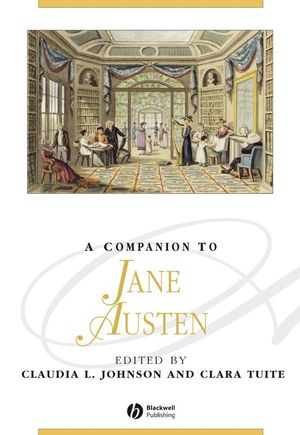
Claudia L. Johnson, Clara Tuite (dir.), A Companion to Jane Austen
Blackwell-Publishing, collection "Blackwell Companions to Literature and Culture", jan. 2009, 560 p.
Présentation de l'éditeur:
Reflecting the dynamic and expansive nature of Austen studies, A Companion to Jane Austenprovides 42 essays from a distinguished team of literary scholars thatexamine the full breadth of the English novelist's works and career.
- Provides the most comprehensive and up-to-date array of Austen scholarship
- Functions both as a scholarly reference and as a survey of themost innovative speculative developments in the field of Austen studies
- Engages at length with changing contexts and cultures of reception from the nineteenth to the twenty-first centuries
Claudia L. Johnson joined the faculty at Princeton in 1994 andnow serves as Department Chair. She specializes in eighteenth- andearly nineteenth-century literature, with a particular emphasis on thenovel. Her books include Jane Austen: Women, Politics, and the Novel (Chicago, 1988), Equivocal Beings: Politics, Gender and Sentimentality in the 1790s (Chicago, 1995), and The Cambridge Companion to Mary Wollstonecraft (Cambridge, 2002), along with editions of Jane Austen's Mansfield Park (Norton, 1998), Sense and Sensibility (Norton, 2002), and Northanger Abbey (Oxford,2003). Her research has been supported by major fellowships such as theNEH and the Guggenheim. She is now finishing a book about author-lovecalled Jane Austen's Cults and Cultures, which traces permutations of “Jane mania” from 1817 to the present, and also working on another called Raising the Novel, which explores modern efforts to create a novelistic canon by elevating novels to keystones of high culture.
Clara Tuiteis Senior Lecturer in English, University of Melbourne. She is theauthor of Romantic Austen: Sexual Politics and the Literary Canon(Cambridge, 2002, 2008), as well as several essays on Austen, and theco-editor, with Gillian Russell, of Romantic Sociability: SocialNetworks and Literary Culture in Britain, 1770-1840 (Cambridge, 2002,2006).
Sommaire:
List of Illustrations.
A Note to the Reader.
Notes on Contributors.
Acknowledgments.
Introduction: Claudia L. Johnson (Princeton University) and Clara Tuite (University of Melbourne).
Part I: The Life and the Texts:.
1. Jane Austen's Life and Letters: Kathryn Sutherland (University of Oxford).
2. The Austen Family Writing: Gossip, Parody, and Corporate Personality: Robert Mack (University of Exeter).
3. The Literary Marketplace: Jan Fergus (Lehigh University).
4. Texts and Editions: Brian Southam.
5. Jane Austen, Illustrated: Laura Carroll (La Trobe University, Melbourne) and John Wiltshire (La Trobe University, Melbourne).
Part II: Reading the Texts:.
6. Young Jane Austen: Author: Juliet McMaster (University of Alberta).
7. Moving In and Out: The Property of Self in Sense and Sensibility: Susan Greenfield (Fordham University).
8. Austen the Illusionist: Northanger Abbey and Austen's Uses of Enchantment: Sonia Hofkosh (Tufts University).
9. Re-Reading Pride and Prejudice: "What think you of books?": Susan Wolfson (Princeton University).
10. The Missed Opportunities of Mansfield Park: William Galperin (Rutgers University).
11. Emma: Wordgames and Secret Histories: Linda Bree (Cambridge University Press).
12. Persuasion: The Gradual Dawning of Greatness: Fiona Stafford (University of Oxford).
13. Sanditon and the Book: George Justice (University of Missouri).
Part III: Literary Genres and Genealogies:.
14. Turns of Speech and Figures of Mind: Margaret Anne Doody (University of Notre Dame).
15. Narrative Technique: Austen and her Contemporaries: Jane Spencer (University of Exeter).
16. Time and her Aunt: Michael Wood (Princeton University).
17. Austen's Realist Play: Harry Shaw (Cornell University).
18. Dealing in Notions and Facts: Jane Austen and History Writing: Devoney Looser (University of Missouri).
19. Sentiment and Sensibility: Austen, Feeling and Print Culture: Miranda Burgess (University of British Columbia).
20. The Gothic Austen: Nancy Armstrong (Brown University).
Part IV: Political, Social and Cultural Worlds:.
21. From Politics to Silence: Jane Austen's Non-Referential Aesthetic: Mary Poovey (New York University).
22. The army, the navy and the Napoleonic Wars: Gillian Russell (Australian National University).
23. Jane Austen, the 1790s and the French Revolution: Mary Spongberg (Macquarie University).
24. Feminisms: Vivien Jones (University of Leeds).
25. Imagining Sameness and Difference: Domestic and Colonial Sisters in Mansfield Park: Deirdre Coleman (University of Melbourne).
26. Jane Austen and the Nation: Claire Lamont (University of Newcastle upon Tyne).
27. Religion: Roger E. Moore (Vanderbilt University).
28. Family Matters: Ruth Perry (Massachusetts Institute of Technology).
29. Austen and Masculinity: E.J. Clery (University of Southampton).
30. The Trouble with Things: Objects and the Commodification of Sociability: Barbara Benedict (Trinity College, CT).
31. Luxury: Making Sense of Excess in Austen's Narratives: Diego Saglia (University of Parma).
32. Austen's Accomplishment: Music and the Modern Heroine: Gillen D'Arcy Wood (University of Illinois, Urbana-Champaign).
33. Austen and Performance: Theatre, Memory and Enculturation: Daniel O'Quinn (University of Guelph).
Part V: Reception and Reinvention:.
34. Jane Austen and Genius: Deidre Lynch (University of Toronto).
35. Jane Austen's Periods: Mary Favret (Indiana University-Bloomington).
36. Nostalgia: Nicholas Dames (Columbia University).
37. Austen's European Reception: Anthony Mandal (Cardiff University).
38. Jane Austen and the Silver Fork Novel: Edward Copeland (Pomona College, Claremont).
39. Jane Austen in the World: New Women, Imperial Vistas: Katie Trumpener (Yale University).
40. Sexuality: Fiona Brideoake (University of Melbourne).
41. Jane Austen and popular culture: Judy Simons (De Montfort University).
42. Austenean Subcultures: Mary Ann O'Farrell (Texas A&M University).
Primary Bibliography.
Bibliography.
Index