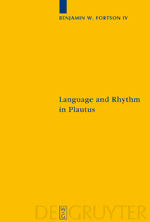
Benjamin W. Fortson IV, Language and rhythm in Plautus: Synchronic and diachronic studies, Berlin; New York: Walter de Gruyter, coll. Sozomena / Studies in the Recovery of Ancient Texts 3, 2008. 250 pages.
- ISBN 9783110205930
- $98.00
Recension par Ariana Traill (University of Illinois at Urbana-Champaign) dans Bryn Mawr Classical Review 2009.08.41.
Présentation de l'éditeur:
The plays of Plautus have long been recognizedas a unique mine of information about the spoken Latin of the 3rd and2nd centuries BC. But detailed and up-to-date linguistic treatments ofthe Plautine meters and other phenomena in his plays have hitherto beenlacking. This book seeks to remedy that gap by presenting a series ofcase-studies to glean information about the synchronic grammar ofPlautine Latin, in particular the rhythmic organization of Latin speechand the effects of syntactic processes on Latin prosodic phonology.Some of the topics, such as enjambement and the aphaeresis of “est”,have never before received such treatment, while others, such asMeyer's and Luchs's laws, split resolutions, and iambic shortening, areprovided a firmer linguistic footing, and fuller discussion of alliedissues, than hitherto. Topics in Italic syntax (such as the syntacticstructure of adpositional phrases and their history) and inIndo-European morphophonology (such as the prosodic status of finiteverbs) are dealt with as well, as is an investigation into the effectsof pragmatics on the rhythmic organization of phrases. The book will beof interest to classicists, comparative philologists, and generallinguists.
Table des matières:
Chapter One: Preliminaries
Chapter Two: Plautine Iambo-Trochaics
Chapter Three: The Linguistic Background of Luchs's Law
Chapter Four: Meyer's and Jacobsohn's Laws
Chapter Five: Enjambement
Chapter Six: The Aphaeresis of Est
Chapter Seven: Breuis Breuians I
Chapter Eight: Breuis Breuians II
Chapter Nine: Towards a Reconstruction of the Prosody of Plautine Latin Speech