Fabula, la recherche en littérature (actu)

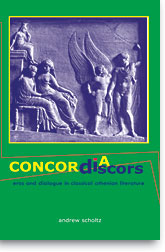
A. Scholtz, Concordia Discors: Eros and Dialogue in Classical Athenian Literature

Parution livre

Information publiée le dimanche 17 août 2008 par Bérenger Boulay


_blank


Andrew Scholtz, Concordia Discors: Eros and Dialogue in Classical Athenian Literature
.

Washington D.C. Center for Hellenic Studies/ Harvard University Press, coll. "Hellenic Studies" n° 24, 2007. ix-174p. (Paperback edition: février 2008).
Isbn (ean13): 978-0-674-02598-1


Recension par Nicholas Rynearson (University of Georgia) dans Bryn Mawr Classical Review: 2008.08.27

Présentation de l'éditeur:

Writing to a friend, Horace describes the man as fascinated by "the discordant harmony of the cosmos, its purpose and power."

 Andrew Scholtz takes this notion of "discordant harmony" and argues for it as an aesthetic principle where classical Athenian literature addresses politics in the idiom of sexual desire. His approach is an untried one for this kind of topic. Drawing on theorists of the sociality of language, Scholtz shows how eros, consuming, destabilizing desire, became a vehicle for exploring and exploiting dissonance within the songs Athenians sang about themselves. Thus he shows how societal tension and instability could register as an ideologically charged polyphony in works like the Periclean Funeral Oration, Aristophanes' Knights, and Xenophon's Symposium.


Url de référence :
http://www.hup.harvard.edu/catalog/SCHCON.html


Derniers ouvrages parus :

A. Alciato, Il libro degli Emblemi, secondo le edizioni del 1531 e del 1534

Marc Azéma, La Préhistoire du cinéma

J. Milly, Au seuil de l'image

I. Mons, Lou Andreas-Salomé. En toute liberté

N. Redouane, Lecture(s) de Rachid Mimouni

Chr. Martin (dir.), Fictions de l'origine (1650-1800)

D. Brooks, The Sons of Clovis : Ern Malley, Adoré Floupette and a Secret History of Australian Poetry

Jean Richepin, Truandailles

C. Meyer-Plantureux, Romain Rolland - Théâtre et engagement

C. Aliberti, Du spasme existentiel à la quête de rédemption

M. Kadima-Nzuji, Théâtre et destin national au Congo-Kinshasa - 1965-1990

Jean-Yves Tadié, Le lac inconnu - Entre Proust et Freud

N. Frogneux (dir)., J. Patocka. Liberté, existence et monde commun

Verlaine, Romances sans paroles (éd. Arnaud Bernadet)

Sandrine Dubel et Alain Montandon (dir.), Mythes sacrificiels et ragoûts d'enfants

Jules Verne, Voyages extraordinaires (éd. J.-L. Steinmetz)

T. Karsenti, Le Mythe de Troie dans le théâtre français (1562-1715)

J. Verne, Les Enfants du capitaine Grant – Vingt mille lieues sous les mers

S. Courant, Approche anthropologique des écritures de voyage

M. Bandello, Novelle / Nouvelles III, 2e part., VI-XXXVIII

J. Pigeaud, Les Loges de Philostrate

L. Bolard, Le voyage et le séjour des peintres en Italie au XVIIe s.

J. N. Bremmer, La religion grecque (rééd.)

H. M. Enzensberger, Culture ou mise en condition ?

Diderot, Est-il bon? Est-il méchant?, éd. P. Frantz (FolioThéâtre)

Fil d'informations RSS Fil d'information RSS   Fabula sur Facebook Fabula sur Facebook   Fabula sur Twitter Fabula sur Twitter