Fabula, la recherche en littérature (actu)

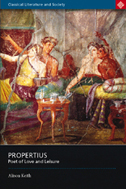
A. M. Keith, Propertius, Poet of Love and Leisure

Parution livre

Information publiée le lundi 22 décembre 2008 par Bérenger Boulay (source : Compitum.fr)


_blank

 A. M. Keith, Propertius, Poet of Love and Leisure, London, Duckworth, coll. "Classical Literature & Society series", nov. 2008, 192p.


ISBN: 9780715634530

Présentation de l'éditeur:

In Propertius: Poet of Love and Leisure, Alison Keith explores Propertius' elegiac poetry in the context of early imperial Roman society. Examining a variety of themes associated with both Propertian poetics (such as genre theory, poetic models, the girlfriend, the rival) and the poet's social context within the early Augustan principate (such as Roman imperialism, the elite male cursus honorum, Augustus' building projects) she offers a synthetic overview of Propertius' achievement in his four books of elegies. She considers the neglected relationship of rhetoric to Propertian elegiac poetics, as well as Propertius' debt to the classical literary tradition, and explores themes in the corpus that reflect the Augustan imperial context in which Propertius lived and wrote.

Arguing for neither a pro- nor an anti-Augustanism on display in Propertian elegy, Keith brings to light the multiple ways in which Roman imperial rule, the new pax Augusta, and new forms of elite Roman political competition intersect in and inform Propertius' poetry. The volume contributes to our understanding of both Latin literature and Augustan culture in its sustained exploration of refractions of the Roman ‘imperialist enterprise' in Propertius' elegiac poetry.

 A.M. Keith is Professor and Chair, Department of Classics, University of Toronto. She is the author of The Play of Fictions: Studies in Ovid's Metamorphoses Book 2 (1992) and Engendering Rome: Women in Latin Epic in the Cambridge series ‘Roman Literature and its Contexts' (2000), and has written extensively on the intersection of gender and genre in Latin literature.


Url de référence :
http://www.ducknet.co.uk/academic/title.php?titleissue_id=894


Derniers ouvrages parus :

A. Alciato, Il libro degli Emblemi, secondo le edizioni del 1531 e del 1534

Marc Azéma, La Préhistoire du cinéma

J. Milly, Au seuil de l'image

I. Mons, Lou Andreas-Salomé. En toute liberté

N. Redouane, Lecture(s) de Rachid Mimouni

Chr. Martin (dir.), Fictions de l'origine (1650-1800)

D. Brooks, The Sons of Clovis : Ern Malley, Adoré Floupette and a Secret History of Australian Poetry

Jean Richepin, Truandailles

C. Meyer-Plantureux, Romain Rolland - Théâtre et engagement

C. Aliberti, Du spasme existentiel à la quête de rédemption

M. Kadima-Nzuji, Théâtre et destin national au Congo-Kinshasa - 1965-1990

Jean-Yves Tadié, Le lac inconnu - Entre Proust et Freud

N. Frogneux (dir)., J. Patocka. Liberté, existence et monde commun

Verlaine, Romances sans paroles (éd. Arnaud Bernadet)

Sandrine Dubel et Alain Montandon (dir.), Mythes sacrificiels et ragoûts d'enfants

Jules Verne, Voyages extraordinaires (éd. J.-L. Steinmetz)

T. Karsenti, Le Mythe de Troie dans le théâtre français (1562-1715)

J. Verne, Les Enfants du capitaine Grant – Vingt mille lieues sous les mers

S. Courant, Approche anthropologique des écritures de voyage

M. Bandello, Novelle / Nouvelles III, 2e part., VI-XXXVIII

J. Pigeaud, Les Loges de Philostrate

L. Bolard, Le voyage et le séjour des peintres en Italie au XVIIe s.

J. N. Bremmer, La religion grecque (rééd.)

H. M. Enzensberger, Culture ou mise en condition ?

Diderot, Est-il bon? Est-il méchant?, éd. P. Frantz (FolioThéâtre)

Fil d'informations RSS Fil d'information RSS   Fabula sur Facebook Fabula sur Facebook   Fabula sur Twitter Fabula sur Twitter